 Chris Robert
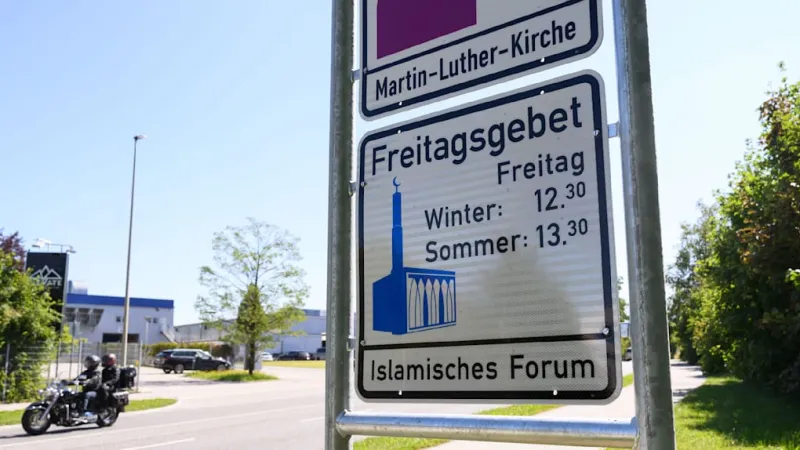
Unknown perpetrators defaced a new public sign indicating Muslim Friday prayer times in Penzberg, upper Bavaria, Germany, just four days after its installation. The incident, which occurred rapidly following the sign's placement, marks a disturbing act of vandalism against what is believed to be the nation's first public announcement of its kind.
The large informational sign, strategically located at the entrance to the town, was intended to inform residents and visitors about the congregational prayer schedules for the local Muslim community. Its unveiling was hailed by many as a significant step towards greater visibility and integration for Muslims in the region.
However, the gesture of inclusion was swiftly met with intolerance. Black paint now obscures portions of the sign, marring its surface and conveying a clear message of rejection. Local authorities have initiated an investigation into the defacement, seeking to identify and apprehend those responsible for the crime.
The act has sparked concern among interfaith dialogue advocates and community leaders across Germany. While the installation of such a sign was a localized decision, its vandalism carries broader implications for religious tolerance and the ongoing challenges of integration within a diverse society.
For many, the sign represented a subtle yet powerful acknowledgment of religious diversity in a public space. Its defacement underscores persistent undercurrents of xenophobia and anti-Muslim sentiment that occasionally surface in German discourse and action.
Officials in Penzberg had hoped the sign would foster mutual understanding, particularly given the town's longstanding Muslim community. Instead, the incident risks escalating tensions and creating an environment of unease for minority groups.
The swiftness of the vandalism, occurring only days after the sign's erection, suggests a premeditated act rather than spontaneous mischief. This aspect has amplified calls for a thorough investigation, with many hoping to uncover any organized motive behind the defacement.
The broader political climate in Germany has seen an uptick in debates surrounding immigration and cultural integration. The rise of parties like the Alternative for Germany (AfD), as discussed in articles such as German Political Landscape Shifts: AfD Leads, SPD Trails Greens, has contributed to a more polarized environment where expressions of religious and cultural identity can become targets of opposition.
This incident is not isolated, but rather reflects a pattern of intolerance seen in various forms across the nation, sometimes extending to challenges against political candidates' loyalty, as highlighted in German Election Boards Challenge AfD Candidates Constitutional Loyalty. Public displays of minority cultures or religions often face scrutiny, and sometimes outright hostility.
Community leaders in Penzberg have condemned the vandalism unequivocally, emphasizing the importance of respect and peaceful coexistence. They have called upon residents to reject such acts of hatred and to uphold the town's values of openness and acceptance.
The police investigation is expected to consider all potential angles, including hate crime motivations. Authorities are appealing to the public for any information that could lead to the identification of the vandals.
This unfortunate event serves as a stark reminder that while progress towards inclusivity is made, it can also face considerable backlash. The defacement of the Muslim prayer sign highlights the continuous effort required to cultivate genuine respect for all faiths and communities in public life.
Efforts are underway to clean the sign and restore it to its original state. However, the symbolic damage inflicted by the act of vandalism will linger, necessitating ongoing dialogue and education to counter prejudice.