 Dorry Archiles
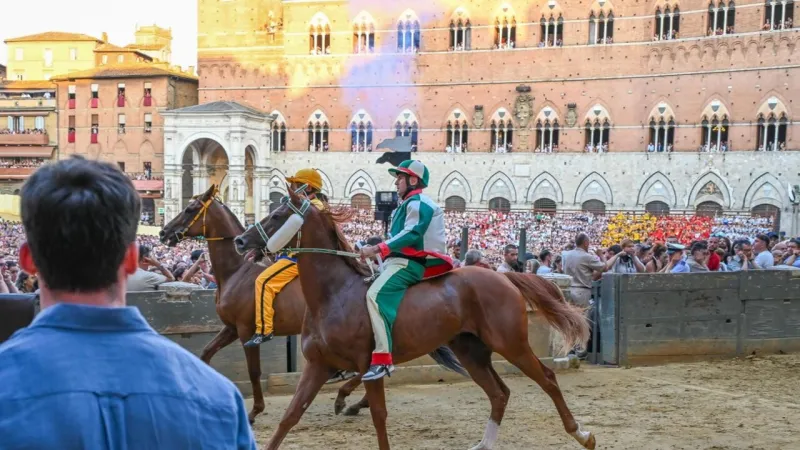
Siena, Italy – The Contrada of L'Oca, often referred to as the Goose, emerged victorious in the crucial general trial for the revered Palio dell'Assunta, a pivotal dress rehearsal ahead of the historic horse race. Jockey Spago, astride the formidable Diamante Sauro, seized and maintained a commanding lead from the third lap, signaling a formidable contender for the coveted banner. This significant win on the Piazza del Campo portends an intense competition as Siena prepares for its celebrated tradition.
This triumph in the prova generale, or general trial, is a morale booster for the L'Oca contrada and a clear statement of intent. The combination of Spago's skilled horsemanship and Diamante Sauro's raw power proved insurmountable for their rivals during the rigorous circuit around the iconic shell-shaped square.
The Palio dell'Assunta, held annually on August 16th in honor of the Assumption of Mary, is far more than a mere race; it is a profound expression of Sienese identity, history, and fierce inter-contrada rivalry. Ten of Siena's seventeen contrade participate in each Palio, drawn by lot, with the remaining seven joining the subsequent race.
Historically, the general trial serves as the penultimate test for both horse and jockey, allowing them to familiarize themselves with the challenging track conditions and the intense atmosphere. While not the official race, a strong performance here often indicates a contrada's readiness and strategic positioning.
Spago, a seasoned fantino, or jockey, demonstrated exceptional control and tactical acumen. His decision to push Diamante Sauro for the lead on the third lap, rather than conserving energy, paid dividends as they skillfully navigated the notoriously tight corners, including the treacherous Curva di San Martino.
Each contrada pours immense resources and passion into their preparations, with months of strategizing, training, and selection culminating in these intense moments. The bond between the contrada members, the jockey, and the assigned horse is palpable, built on a shared desire for victory.
The Piazza del Campo, typically a bustling public square, transforms into a temporary racetrack for the Palio. Its uneven cobblestone surface and sharp turns demand supreme skill from the jockeys and unwavering courage from the horses. Spectators, both local and international, line the piazza and fill surrounding buildings, creating an electrifying tableau.
The Palio's origins trace back to medieval times, evolving from ancient public games and horse races that celebrated civic pride and religious devotion. It remains one of Italy's most authentic and visceral traditions, largely unchanged by the passage of centuries.
The win for L'Oca will undoubtedly send ripples through the other competing contrade. It forces rivals to reassess their own strategies and perhaps intensify their focus on the specific challenges posed by L'Oca's pairing of Spago and Diamante Sauro.
The selection of horses, often a contentious process, is crucial. Diamante Sauro's performance suggests that L'Oca made an astute choice, with the horse displaying both speed and resilience under pressure. The rapport between jockey and horse is paramount for success in this bareback race where no saddles are used.
Local Siena residents, deeply invested in their contrada's fortunes, have already begun their ritualistic celebrations and anxious discussions. The city hums with an almost palpable energy, a blend of age-old customs and modern anticipation.
The Palio transcends mere sport, becoming a cultural phenomenon. Its unique blend of pageantry, religious ceremony, and fierce competition captivates audiences worldwide. The vibrant banners, historical costumes, and thunderous drumbeats are all part of an unforgettable spectacle.
Italy has recently celebrated other significant athletic accomplishments, such as when Martinenghi secured double gold, dominating European swimming in Paris, reflecting a nationwide passion for competition. The Palio, while steeped in tradition, embodies this same intense competitive spirit on a local, deeply personal level.
The days leading up to the main Palio dell'Assunta will see further trials, blessings of the horses in their respective contrada churches, and elaborate historical parades. These rituals are integral to the event, building an almost unbearable tension before the final race.
Despite the rigorous trials, the Palio remains famously unpredictable. A fall, a poor start, or an unexpected maneuver can change the outcome in an instant. The race is short, typically lasting just over a minute, making every second critical.
L'Oca's dominant performance in the general trial provides a strong psychological edge, yet the true test awaits on the main day. The Palio dell'Assunta is a testament to the enduring power of tradition and the indomitable spirit of competition.
The entire city now holds its breath, counting down the hours until the definitive contest, where only one contrada will claim the ancient banner and eternal bragging rights. L'Oca has shown its hand, and the other nine contrade are now challenged to respond on the grandest stage.
Anticipation for the Palio dell'Assunta is now at an fever pitch, with all eyes fixed on the Piazza del Campo for what promises to be a dramatic and unforgettable race.