 Robert Andrison
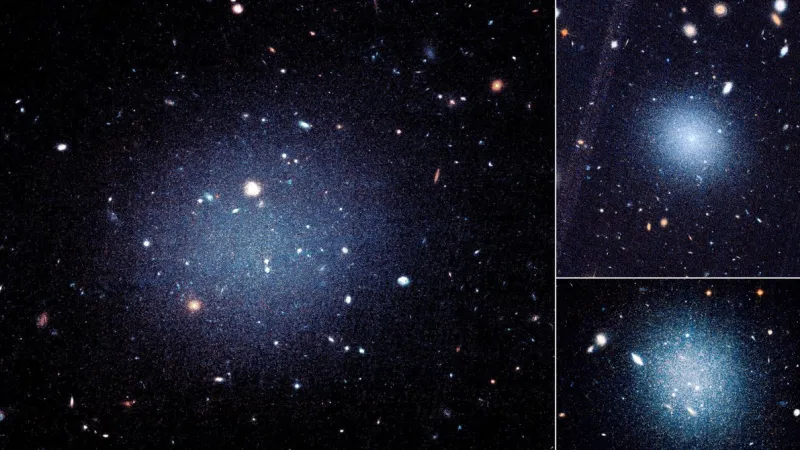
WASHINGTON D.C. – A groundbreaking discovery by an international team of astronomers has revealed several distant galaxies almost entirely devoid of dark matter, a phenomenon attributed to violent galactic collisions. This unexpected cosmic anomaly, observed through advanced telescopic data, paradoxically provides some of the most compelling direct evidence yet for the existence of the elusive substance that constitutes approximately 27% of the universe's mass.
For decades, dark matter has remained one of the most significant mysteries in cosmology. It is an invisible, non-baryonic form of matter that does not interact with light or other electromagnetic forces, making it undetectable by conventional means. Its presence is inferred solely through its gravitational effects on visible matter, such as stars and gas, and the overall structure of the universe.
The newly identified galaxies present a stark contrast to typical galactic structures, which are thought to be embedded within vast halos of dark matter. Researchers identified these anomalies by meticulously analyzing the movements of stars and gas within the galaxies, noting a distinct lack of the gravitational pull expected from a substantial dark matter component. This absence stood out against the standard models of galaxy formation and evolution.
Scientists propose that these ghostly galaxies were stripped of their dark matter during high-speed, head-on collisions with other massive galaxies. In such cosmic impacts, the diffuse dark matter halos, which are less gravitationally bound than the denser clumps of visible stars and gas, could be ejected into the vast emptiness of intergalactic space. The visible matter, possessing greater inertia and tighter gravitational bonds, would largely pass through, albeit perturbed, retaining its integrity.
This scenario offers a unique natural experiment for astrophysicists. By observing how dark matter behaves separately from ordinary matter during extreme cosmic events, scientists gain unprecedented insights. The finding strengthens the prevailing dark matter paradigm, providing empirical support for its physical properties and gravitational interactions.
The irony inherent in this discovery is profound: the definitive absence of dark matter in these specific galaxies provides its strongest evidence. Previously, the case for dark matter relied heavily on indirect observations, such as the anomalous rotation curves of spiral galaxies, the patterns in the cosmic microwave background radiation, and the gravitational lensing effects observed around galaxy clusters. These phenomena all suggest a hidden mass far exceeding what visible matter alone can account for.
This direct observation of dark matter separation from baryonic matter during collisions challenges some alternative theories of gravity that attempt to explain cosmic phenomena without invoking dark matter. While these theories propose modifications to Einsteins theory of general relativity, they struggle to explain how such a clean separation of gravitational effects could occur without a distinct dark matter component.
The implications for our understanding of galaxy formation and evolution are significant. Current cosmological models posit that dark matter halos act as gravitational scaffolds, pulling in ordinary gas to ignite star formation and shape the galaxies we observe. The existence of galaxies nearly devoid of this scaffolding prompts new questions about their developmental pathways and survival mechanisms.
Furthermore, this observation provides crucial data points for refining simulations of galactic interactions and the nature of dark matter particles themselves. While the exact composition of dark matter remains unknown, candidates like Weakly Interacting Massive Particles, or WIMPs, would exhibit behaviors consistent with this observed cosmic stripping.
Future research will undoubtedly focus on identifying more such dark matter-deficient galaxies and conducting more detailed analyses of their kinematics and composition. Advanced telescopes and new observational techniques will be pivotal in expanding this groundbreaking work, offering further opportunities to probe the fundamental nature of the universe.
Despite these advancements, the ultimate detection and characterization of dark matter particles remain one of the foremost challenges in physics. Laboratory experiments, such as those at the Large Hadron Collider and dedicated underground dark matter detectors, continue their arduous search for direct evidence of these elusive particles.
The international scientific collaboration behind this discovery underscores the global effort dedicated to unraveling the cosmos deepest secrets. Researchers from multiple institutions contributed their expertise in observational astronomy, theoretical astrophysics, and computational modeling to piece together this extraordinary cosmic narrative.
This finding serves as a critical piece in the intricate puzzle of the universe's composition and evolution. It moves beyond theoretical predictions to tangible cosmic events, offering a powerful validation of the standard cosmological model and reinforcing the ongoing quest to understand the invisible forces shaping our existence.
The scientific community anticipates further studies to confirm these initial findings and potentially uncover additional examples of dark matter separation. Each new observation brings humanity closer to comprehending the fundamental laws that govern the vastness of space.
This unprecedented look into the aftermath of cosmic collisions offers a compelling illustration of how the universe itself provides the most intricate and informative laboratories for fundamental physics.