Robert Andrison
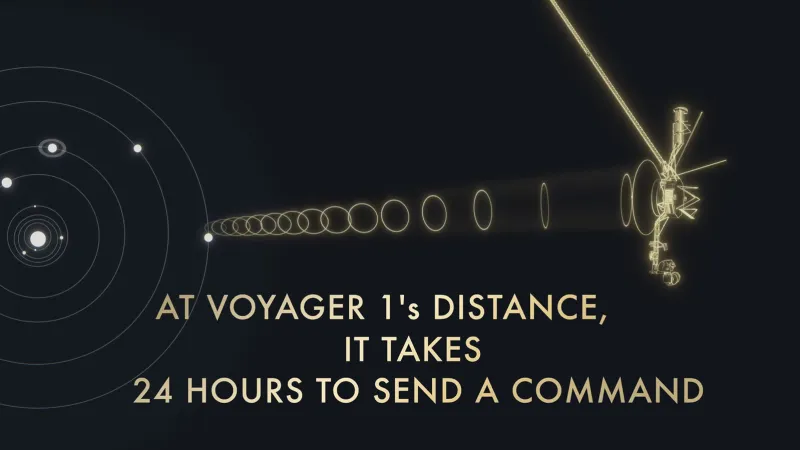
NASA's venerable Voyager 1 space probe has achieved a remarkable new milestone, officially reaching a distance of one light-day from Earth. This colossal interstellar journey now means communications with the spacecraft require a full 24 hours for a round trip signal, underscoring the probe's unprecedented voyage into the cosmos.
This latest benchmark highlights the immense scale of space exploration. A light-day, equivalent to approximately 16.5 billion miles (26.5 billion kilometers), represents the distance light travels in a single 24-hour period. For mission controllers at NASAs Jet Propulsion Laboratory, this translates into a full day of waiting for confirmation after sending a command to the distant explorer.
Launched on September 5, 1977, Voyager 1 was initially designed for a five-year mission to study Jupiter and Saturn. It exceeded all expectations, becoming the first spacecraft to provide detailed images of these gas giants and their moons, forever changing our understanding of the outer solar system.
After completing its primary planetary encounters, the probe embarked on an extended mission, becoming the first human-made object to cross the heliopause and enter interstellar space in August 2012. It now navigates the uncharted territory between stars, providing scientists with direct measurements of the interstellar medium.
The engineering marvel continues to transmit scientific data back to Earth, though at extremely low data rates and with significantly degraded power. Its instruments measure cosmic rays, magnetic fields, and plasma waves, offering unique insights into the environment beyond our solar bubble. Each piece of data received is a testament to the durability and ingenuity of its original design.
Maintaining contact with Voyager 1 presents considerable challenges. The signals are incredibly faint, requiring massive deep space network antennas across the globe to capture them. Mission engineers meticulously manage the probes dwindling power supply, selectively shutting down instruments to conserve energy for critical operations and data transmission.
Its twin probe, Voyager 2, launched 16 days earlier, also crossed into interstellar space in 2018. While following a slightly different trajectory, Voyager 2 similarly continues to send back valuable scientific data, contributing to a broader understanding of our solar systems edge and beyond.
The Voyager program has fundamentally reshaped humanitys perspective on its place in the universe. For nearly half a century, these probes have acted as our eyes and ears in regions previously unimagined, pushing the boundaries of what is technologically possible in space exploration.
Scientists anticipate Voyager 1 will continue to operate for several more years, potentially until around 2030, before its power source completely diminishes. At that point, it will silently drift further into the Milky Way, carrying with it the Golden Record, a time capsule of Earth sounds, images, and greetings intended for any intelligent extraterrestrial life it might encounter.
The achievement of Voyager 1 reaching a light-day distance serves as a powerful reminder of humanitys insatiable drive to explore. It sets a precedent for future interstellar missions, highlighting both the opportunities and profound technical challenges involved in venturing to the stars. The probes journey continues to inspire generations, embodying the spirit of scientific discovery and the relentless pursuit of knowledge.