 Dodi Irawan
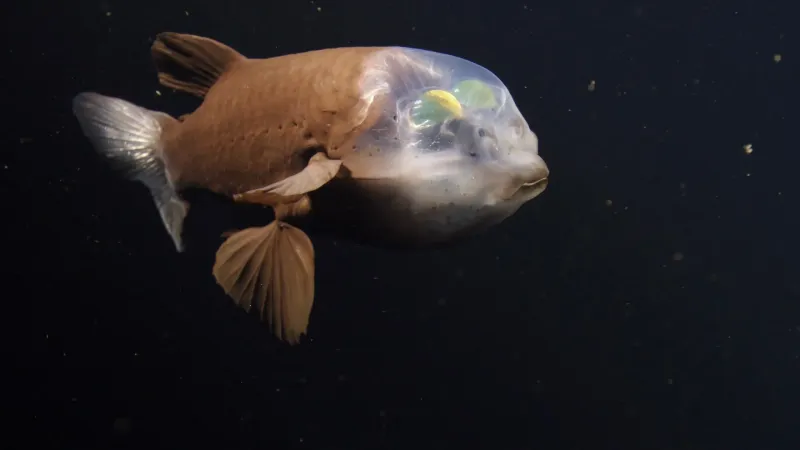
Deep-sea researchers recently unveiled unprecedented 4K video footage of the extraordinarily rare barreleye fish, a creature distinguished by its transparent head and unique rotating eyes, observed nearly 2,000 feet below the Pacific Ocean's surface during an expedition. This remarkable encounter provides critical new insights into the biology and behavior of one of the ocean's most enigmatic inhabitants.
The barreleye fish, scientifically known as Macropinna microstoma, possesses one of the most bizarre and highly specialized adaptations in the animal kingdom. Its most striking feature is a fluid-filled transparent dome that covers its head, protecting its barrel-shaped, tubular eyes.
These specialized eyes, which appear as two large green spheres within the dome, are typically pointed upwards. This orientation allows the fish to scan the dimly lit waters above for the silhouettes of prey, such as small crustaceans and other organisms, silhouetted against the faint sunlight filtering down from the surface.
What makes this new footage particularly significant is the clarity with which it demonstrates the fishs ability to rotate these tubular eyes forward. When the barreleye spots potential prey, it swiftly swivels its eyes to face directly ahead, enabling precise tracking and targeting of its next meal.
This hunting strategy is crucial for survival in the mesopelagic zone, often referred to as the twilight zone, where light is scarce and competition for food is intense. The transparent skull provides a wide field of vision while offering protection from the stinging tentacles of siphonophores, which share its habitat.
Previous observations of the barreleye fish, first described in 1939, were often limited to specimens damaged by nets or collected from submersibles that could not capture its delicate features in motion. The high-resolution 4K video footage now offers an unparalleled view into its living anatomy and behavior.
The deep ocean remains one of Earths least explored frontiers, a realm characterized by crushing pressure, perpetual darkness, and frigid temperatures. Discoveries like that of the barreleye fish underscore the vast biodiversity still hidden within these extreme environments.
Advanced remotely operated vehicles, or ROVs, equipped with high-definition cameras and specialized lighting, are instrumental in making these groundbreaking observations possible. These robotic explorers can withstand the intense pressures that human submersibles cannot, venturing into depths once considered inaccessible.
Each new sighting and captured footage of such unique species contributes invaluable data to marine biologists. It helps them piece together the complex tapestry of deep-sea ecosystems, understand evolutionary adaptations, and assess the overall health of our planets oceans.
The awe-inspiring nature of the barreleye fish reminds us of the endless wonders harbored by the deep sea. It serves as a powerful testament to the ingenuity of nature and the ongoing imperative to explore and protect these mysterious underwater worlds for future generations.