 Chandra Wijayanto
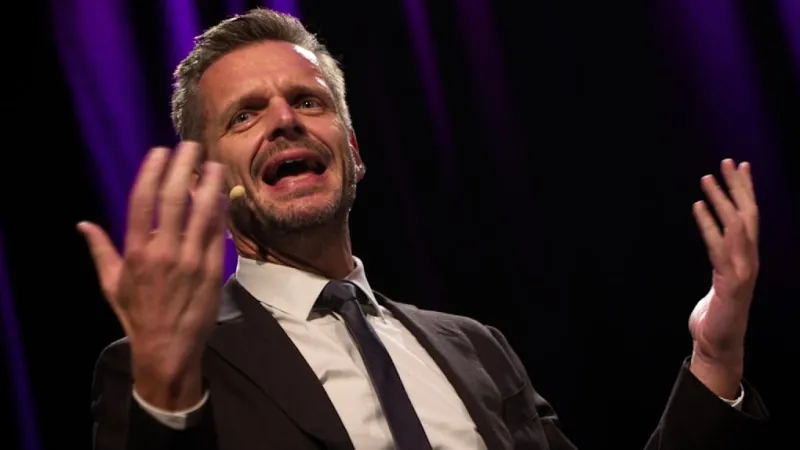
BERLIN – The Free Democratic Party's (FDP) commitment to engaging in what it terms culture wars has drawn sharp rebuke from satirist and commentator Florian Schroeder, who asserts that the strategy fundamentally undermines the very liberalism the party purports to defend. FDP Secretary-General Hagen, in a recent contentious discussion with Schroeder, not only reaffirmed this confrontational approach but also dismissed concerns regarding party members potentially monetizing the act of publicly insulting political figures.
Secretary-General Hagen's remarks underscored a strategic pivot within the FDP, indicating a readiness to embrace ideologically charged debates on cultural issues. His assertion was made during a televised debate with Schroeder, where the FDP's direction and its perception among the German public were central topics of discussion.
The FDP, a liberal party that traditionally advocates for economic freedom and individual liberties, has increasingly found itself navigating a complex political landscape marked by heightened identity politics. Hagen's statements suggest a deliberate calculation to engage these societal flashpoints rather than sidestep them, possibly aiming to energize a specific segment of its voter base.
A particularly provocative aspect of Hagen's commentary revolved around allegations that some FDP members have developed a business model by initiating legal actions over perceived insults from other politicians. This practice, leveraging existing defamation laws, has been criticized by some as an opportunistic exploitation of political discourse for personal gain.
When pressed on this controversial phenomenon, Hagen reportedly stated, "Don't hate the player, hate the game." This aphorism implies a broader critique of the political system or prevailing norms, suggesting that the individuals are merely adapting to an environment that allows such practices, rather than directly condoning or condemning their actions.
Florian Schroeder, known for his incisive political commentary and satirical observations, did not mince words in his criticism. He contended that the FDP's embrace of culture wars and its apparent tolerance for profiting from political invective directly contradict the core tenets of liberalism.
Schroeder argued that a liberal party should foster open debate and protect freedom of expression, even when it is critical or challenging. By engaging in and, at times, seemingly encouraging confrontational culture wars, the FDP risks alienating moderate voters and undermining the very principles of pluralism and tolerance that are foundational to a liberal society.
The debate highlights a broader ideological tension within modern liberal parties. As political discourse becomes more polarized, the definition and application of liberalism are continually reevaluated. Schroeder's critique suggests that a party claiming liberal heritage must carefully consider how its tactics align with its professed values, especially when those tactics involve heightened confrontation.
Observers note that the FDP's strategy could be an attempt to carve out a distinct identity amidst Germany's diverse political spectrum, particularly in the face of rising populist sentiment. However, this approach carries the inherent risk of being perceived as opportunistic or, as Schroeder suggests, antithetical to its own foundational philosophy.
This internal FDP debate unfolds against a backdrop of complex coalition politics in Germany. The FDP is a junior partner in the current governing coalition, engaged in discussions such as those for a German Coalition Leaders Seek Landmark Pension, Tax Agreement, and its policy positions often draw significant scrutiny. The party's engagement in culture wars could be interpreted as an attempt to assert its identity and influence within the coalition, potentially differentiating itself from its larger partners.
Moreover, the broader German political landscape has seen a rise in intense debates on social and cultural issues, often fueled by various political factions. Comedian Dieter Nuhrs Male Defense Ignites Fierce Feminist Backlash provides a parallel example of how public figures and cultural commentary can quickly become central to these societal conflicts, drawing significant public attention and debate.
The FDP's stance on these issues, as articulated by Secretary-General Hagen, will undoubtedly continue to shape perceptions of the party. The party leadership faces the challenge of reconciling its commitment to individual freedom and market principles with its strategic decision to actively participate in culturally charged battles.
The conversation between Schroeder and Hagen underscores the critical juncture at which German liberalism finds itself. The pursuit of political relevance through cultural engagement is a high-stakes gamble, with its proponents hoping to capture public attention while critics warn of the potential erosion of core liberal values. The long-term impact of this strategy on the FDP's identity and its role in German politics remains to be seen.