 Debby Wijaya
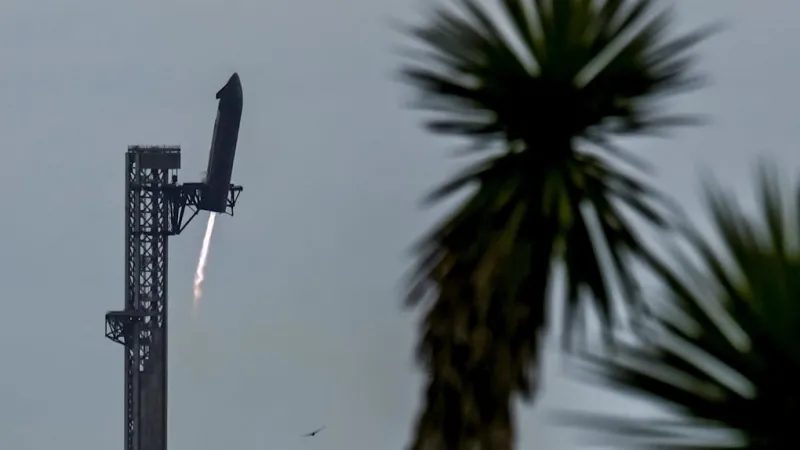
BROWNSVILLE, Texas – SpaceX has achieved a monumental aerospace milestone, successfully catching the Starship rocket's massive Super Heavy booster stage with robotic arms on its launch tower. This unprecedented engineering feat occurred during the vehicle's 15th integrated flight test at the Starbase facility in southern Texas, marking a pivotal moment in the quest for fully reusable space transportation.
For the first time in spaceflight history, a rocket of this magnitude was captured directly at its launch mount, eliminating the need for a traditional landing burn on legs. The maneuver, often described as a “chopstick catch” by SpaceX engineers, involves large mechanical arms extending from the launch tower to grasp the returning booster just before it touches down.
This intricate operation represents a significant leap forward from the company's previous reusable rocket technology, notably the Falcon 9, which employs propulsive landings on landing pads or autonomous drone ships. The Starship system aims for a far more ambitious level of reusability, mirroring the quick turnaround of commercial aircraft.
Engineers, under the visionary leadership of Elon Musk, have meticulously developed and refined this complex capture system over several years. The precision required for the Super Heavy booster, standing at an imposing 230 feet tall, to align perfectly with the tower's catching mechanisms is immense, underscoring the technical mastery involved.
The successful catch drastically streamlines recovery operations. By eliminating the need for landing legs, which add weight and complexity, and by recovering the booster directly at its launch site, SpaceX can theoretically reduce refurbishment time and costs, accelerating the pace of future launches.
This achievement is central to SpaceXs long-term objectives for Starship, which include facilitating human missions to the Moon and Mars. Full and rapid reusability is deemed essential for making such ambitious deep-space travel economically viable and routine, a vision consistently articulated by Musk.
The 15th flight test saw the Starship upper stage, a separate component from the booster, also perform a successful ascent and orbital trajectory, further demonstrating the integrated system's capabilities. While the primary focus of this test was the booster catch, the overall mission profile contributed valuable data for future refinements.
Previous Starship test flights have focused on various aspects of the system's performance, from engine ignition and ascent to in-flight maneuvers and splashdown attempts. Each flight provides critical data points that inform design improvements and operational protocols for the evolving rocket program.
This latest success reinforces SpaceXs reputation for pushing the boundaries of aerospace engineering and challenging conventional wisdom in rocket design. The company continues to operate at a rapid developmental pace, embracing iterative testing as a core methodology.
The implications of this breakthrough extend beyond mere technical prowess. A truly reusable and rapidly launchable heavy-lift rocket could transform space logistics, making access to orbit and beyond considerably cheaper and more frequent. This shift could democratize space, enabling a broader range of scientific, commercial, and exploratory endeavors.
Experts in the aerospace community are watching Starship's development closely, recognizing its potential to reshape the global space industry. The ability to launch and recover the entire system quickly and efficiently holds the promise of unlocking new frontiers in space exploration and resource utilization.
While challenges remain in fully operationalizing Starship for routine commercial and governmental missions, this historic booster catch represents a monumental stride. It underscores the innovative spirit driving the company's ambitious goals for human expansion into the solar system.