 Angela Stefani
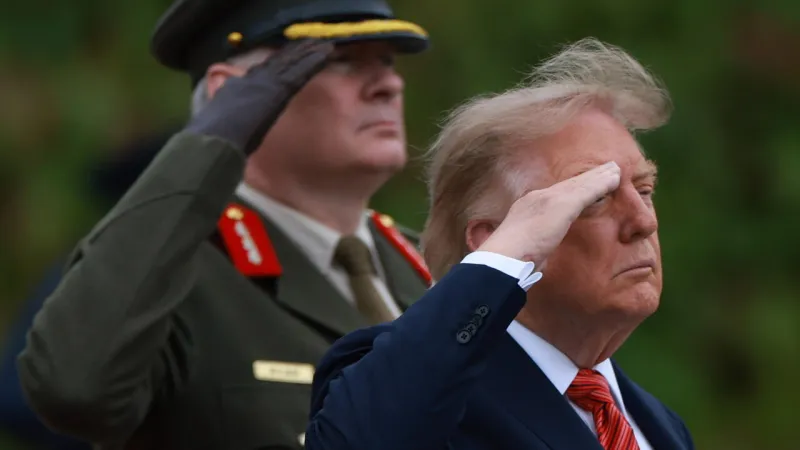
Dublin – President Donald Trump, during a two-day diplomatic visit to the island of Ireland, declared that a united Ireland "would be fantastic," a pronouncement that immediately drew a cautious response from political circles, with a prime ministers spokesman emphasizing the absence of public support for such a constitutional change.
President Trumps itinerary for the brief but high-profile trip included a mix of official engagements and more informal activities, such as a round of golf. His comments on Irish unity emerged amidst these events, adding a notable point of discussion to the visit.
The statement, while not an official policy pronouncement from the White House, offers a glimpse into President Trumps personal perspective on one of Europes most sensitive geopolitical questions. Such remarks from a sitting US President carry significant weight, regardless of their immediate policy implications.
The notion of a united Ireland involves the amalgamation of the Republic of Ireland, an independent sovereign state, and Northern Ireland, which remains part of the United Kingdom. This concept holds deep historical, cultural, and political resonance across the island.
The question of Irish unity has been a central and often contentious issue for centuries, culminating in the partition of Ireland in 1921. The Good Friday Agreement of 1998 established a framework for peace and cooperation, including mechanisms for a border poll on unity if conditions warrant.
Reacting to President Trumps remarks, a spokesman for the Prime Minister reiterated the governments long-standing position. The spokesman stated unequivocally, "There is no public support for a united Ireland at this time." This highlights the official stance that any such change would require demonstrable consent.
The figure referenced as Burnham in the original report, likely a prominent political voice, further underscored the current sentiment. This figure conveyed that popular opinion in Northern Ireland, specifically among both nationalist and unionist communities, does not currently indicate a widespread desire for unification.
Achieving a united Ireland would involve intricate negotiations and significant shifts in identity, governance, and economic structures. Public opinion remains deeply divided, with unionists largely favoring continued ties with the United Kingdom and nationalists generally supporting unification.
President Trumps comments inject the high-stakes issue of Irish unity into a broader international discourse, potentially influencing future discussions. However, the immediate practicalities of such a move remain firmly rooted in local politics and the consent principle enshrined in peace agreements.
The United States has historically played a crucial role in the Northern Ireland peace process, acting as a guarantor and facilitator of dialogue. US presidents, including President Trump, have traditionally emphasized the importance of upholding the Good Friday Agreement.
While symbolic, a US Presidents direct expression of support for a united Ireland differs from previous administrations which typically maintained a more neutral stance on the constitutional question, focusing instead on peace and stability.
Beyond the political and identity debates, the economic ramifications of a united Ireland present substantial challenges and opportunities. Experts often cite the need for comprehensive economic modeling and integration planning.
Any movement towards a border poll and potential unification requires a clear demonstration of public desire, typically assessed through opinion polls and electoral results over time. Current data, as suggested by the Prime Ministers spokesman, does not indicate this threshold has been met.
The statements from President Trump underscore the continued international interest in the future of the island of Ireland and the delicate balance of its regional dynamics. The conversation about unification persists as a key, albeit sensitive, political topic.