 Chris Robert
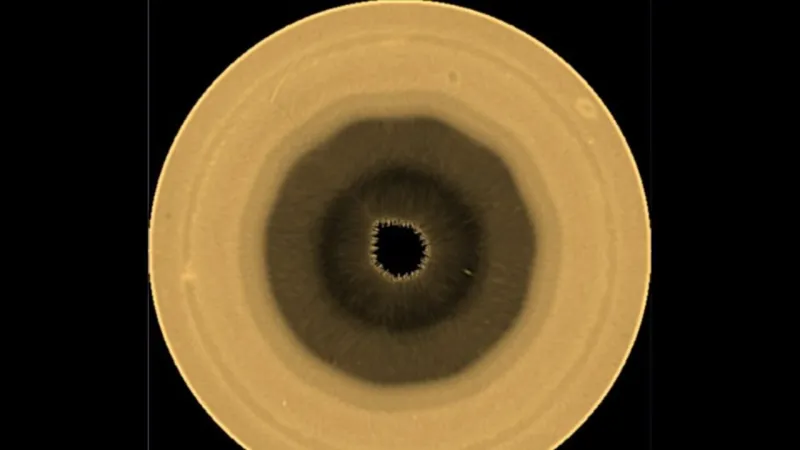
Scientists have recently confirmed the emergence of an enormous decagonal, or ten-sided, atmospheric feature swirling at Saturn's south pole, a captivating discovery attributed to the planet's complex and powerful atmospheric currents. This newly observed geometric pattern draws immediate comparisons to the long-studied, stable hexagonal storm system that dominates Saturn's north pole, offering new insights into the gas giant's dynamic weather phenomena.
This colossal weather system, a vortex of unprecedented scale, has baffled planetary scientists since its initial detection by advanced orbital observations. The decagon's sheer size and its remarkably symmetrical form challenge existing models of planetary atmospheric dynamics, pushing researchers to re-evaluate the forces that shape such stable, long-lived structures within gaseous bodies.
The discovery was made possible through sophisticated imaging and data analysis techniques from various space missions observing Saturn in 2026. While details on specific instrumentation are still being processed, preliminary reports indicate that the feature is a robust and persistent component of the south polar atmosphere, similar in its enduring nature to its northern counterpart.
The northern polar hexagon, first properly imaged by the Voyager missions in the early 1980s and later studied in exquisite detail by the Cassini spacecraft, has long been one of the solar system's most enigmatic meteorological phenomena. It is a stable, six-sided jet stream, hundreds of kilometers deep, that encircles a massive hurricane-like storm.
Researchers hypothesize that the newly observed southern decagon is also a manifestation of high-speed jet streams, where powerful winds, constrained by the Coriolis effect and the planet's rapid rotation, create standing waves. These waves then interact to form polygonal boundaries, effectively trapping atmospheric gases within their confines.
The precise mechanisms that allow these geometric shapes to stabilize and persist for decades, if not centuries, remain an active area of scientific inquiry. The presence of both a hexagon and a decagon on the same planet suggests a rich diversity of atmospheric configurations possible under varying conditions, such as temperature, pressure, and the specific distribution of internal heat.
Comparing the two polar structures will be crucial for understanding the underlying physics. While the north pole's hexagon is well-documented, the south pole presents a different set of atmospheric conditions, including a slightly warmer temperature profile and different seasonal solar illumination, which could influence the formation and stability of its unique decagonal shape.
Planetary scientists are now intensely focused on modeling these phenomena, utilizing supercomputing resources to simulate Saturn's deep atmosphere. The goal is to replicate the conditions necessary for such polygons to form and persist, thereby validating theories about fluid dynamics on a planetary scale and enhancing our comprehension of gas giant meteorology.
This discovery underscores the ongoing revelations from exploring our solar system. Each new observation of planets like Saturn offers a deeper understanding of their complex systems and, by extension, provides valuable comparative data for exoplanetary studies, helping us interpret observations of worlds far beyond our own.
Further missions to Saturn, or extended observation periods from existing orbital assets, will undoubtedly provide more granular data on the decagon's composition, vertical extent, and temporal evolution. Such data is vital for confirming current hypotheses and potentially uncovering entirely new principles of atmospheric physics.
The scientific community remains vigilant, leveraging every bit of available data to unravel the mysteries of Saturn's mesmerizing polar vortices. The decagon at the south pole serves as a powerful reminder of the hidden wonders awaiting discovery, continually challenging and expanding humanity's cosmic perspective.