 Debby Wijaya
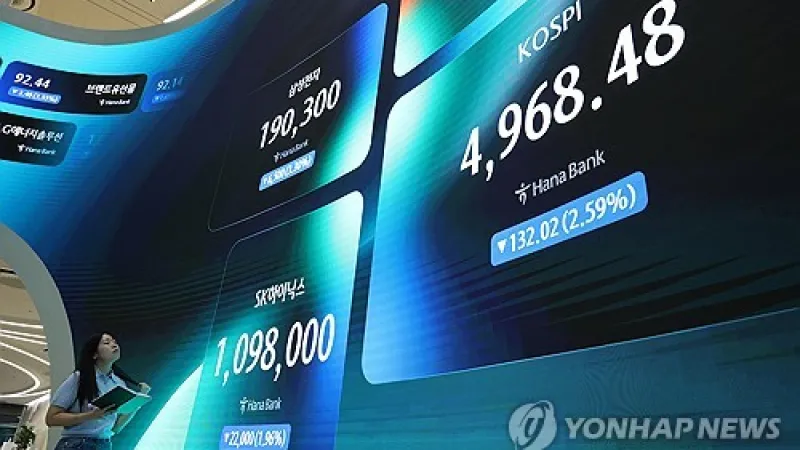
SEOUL, November 17, 2026 – South Korean equities experienced a fourth consecutive day of decline, with the benchmark Kospi index plummeting further as investor anxieties surrounding the long-term implications and immediate challenges within the artificial intelligence sector continued to weigh heavily on market sentiment, particularly impacting technology-focused stocks.
The Kospi closed down 0.75 percent, or 18.23 points, at 2,408.97, extending a losing streak that has seen billions wiped off market capitalization this week. Trading volume was moderate, with approximately 580 million shares exchanging hands for a value of 10.5 trillion won (about 7.6 billion dollars).
The consistent downturn reflects a broader uncertainty regarding the profitability and regulatory landscape surrounding advanced AI technologies. While early enthusiasm fueled significant investment, a period of reassessment appears underway, prompting investors to divest from speculative holdings.
Foreign investors were net sellers, offloading shares worth 250 billion won. Institutional investors also followed suit, divesting 180 billion won. Retail investors, conversely, sought to capitalize on lower valuations, acquiring shares valued at 420 billion won.
Market analysts attribute the persistent selling pressure to a confluence of factors, including global economic slowdown fears, but primarily highlight the shifting narrative around artificial intelligence. Initial exuberance has given way to more cautious evaluations of AI's integration into various industries.
Major technology firms, particularly those heavily invested in AI development and chip manufacturing, bore the brunt of the selling. Samsung Electronics, a bellwether for the Korean market and a global chip giant, saw its shares fall by 1.2 percent. SK Hynix, another significant player in the memory chip sector, also registered a decline of 1.8 percent.
The regulatory environment for AI is also a burgeoning concern. Governments worldwide are grappling with how to effectively govern rapidly evolving AI technologies. South Korea, for example, has seen proposals such as the Seoul ruling party proposing a 10-year exam ban for AI cheating, underscoring societal anxieties. Read more about the government's stance here: Seoul Ruling Party Proposes 10-Year Exam Ban for AI Cheating and Seoul Launches Task Force Against Rising AI Cheating Threat.
Concerns extend beyond immediate profits, touching upon ethical implications, job displacement, and the potential for misuse, all of which contribute to an unpredictable investment climate. This cautious approach contrasts sharply with the optimistic projections that characterized the AI sector earlier in the year.
The won concluded the trading day at 1,364.5 against the U.S. dollar, marking a decrease of 3.2 won from the previous session's close. This depreciation adds another layer of concern for import-reliant industries and potentially exacerbates foreign capital outflows.
Bond markets also reflected the conservative shift, with the yield on the benchmark three-year government bond rising 2.1 basis points to 3.784 percent, indicating higher borrowing costs. The yield on the 10-year government bond also advanced by 2.6 basis points to 3.869 percent.
Observers suggest that the market may not find stable footing until more clarity emerges regarding both the economic outlook and the trajectory of AI development and regulation. Investors are seeking concrete evidence of sustainable business models and robust safeguards before committing further capital.
The current downturn underscores the volatile nature of pioneering technological shifts. While AI's transformative potential remains undisputed, the path to its widespread and profitable integration is proving to be more complex and fraught with challenges than initially perceived by many market participants.