 Demian Sahputra
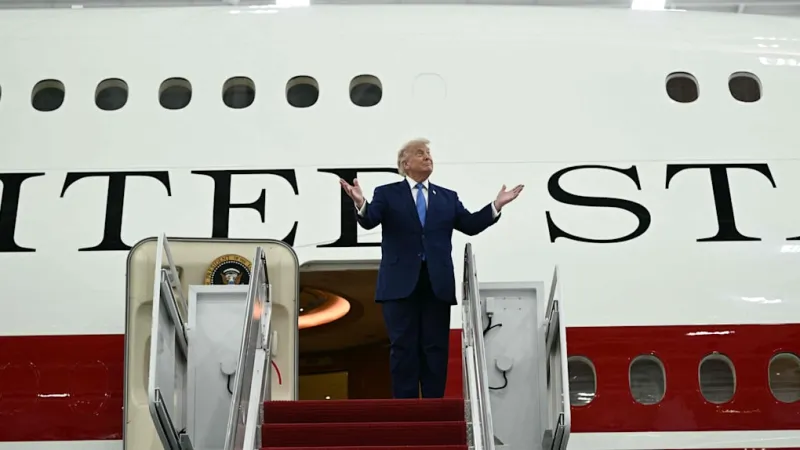
President Donald Trump publicly lauded Qatar during the inauguration of a new Air Force One aircraft, acknowledging the Gulf state’s controversial $400 million contribution towards the presidential jet amid significant public and political scrutiny. The ceremony, held recently, saw the President express profound gratitude for what he termed Qatar’s “niceness,” reigniting debate over foreign donations to US presidential assets.
The unveiling of the state-of-the-art aircraft, designed to serve as the President’s primary mode of air travel, drew attention not only for its technological advancements but also for its funding source. The substantial financial backing from Qatar has been a point of contention since its initial announcement.
Critics argue that such a large gift from a foreign government, particularly one with its own complex geopolitical interests, raises questions of influence and potential conflicts of interest for the US presidency. These concerns have persisted despite the administration’s assurances of transparency.
During the inauguration event, President Trump praised Qatar profusely, stating that the nation had been “so nice” in its support for the project. His remarks underscored the administration’s appreciation for the unexpected financial assistance.
The $400 million allocation from Qatar was reportedly directed towards various enhancements and features of the new presidential aircraft, a detail that further fueled the controversy. Standard protocol usually dictates that such significant assets are funded entirely through congressional appropriations.
Historically, US presidential aircraft, officially designated as Air Force One when the President is aboard, are funded through the defense budget, ensuring public oversight and accountability. The deviation from this norm sparked considerable discussion among lawmakers and policy experts.
Acknowledging the criticism, White House officials previously defended the acceptance of the funds by characterizing them as a gesture of goodwill from an important strategic ally. They maintained that the gift adhered to all relevant legal and ethical guidelines.
However, watchdog groups and several members of Congress have called for a thorough investigation into the specifics of the Qatari contribution, seeking clarity on its exact purpose and any conditions that may have been implicitly or explicitly attached.
The issue is particularly sensitive given previous instances where foreign financial dealings involving high-ranking US officials have drawn scrutiny. The appearance of undue influence, even if unfounded, can erode public trust in government institutions.
The new Air Force One aircraft represents a significant upgrade in technology and capabilities, intended to ensure the President’s secure and efficient travel globally. Its features include advanced communication systems, robust defensive measures, and extended range.
While the focus of the ceremony was ostensibly on the capabilities of the new presidential jet, the underlying financial arrangement with Qatar remained a prominent talking point among political commentators. The optics of a foreign nation funding a key presidential asset continue to generate debate.
President Trump’s warm reception of the Qatari contribution contrasts with the more cautious approach typically adopted by previous administrations regarding gifts of this magnitude from foreign entities. This stance has been interpreted by some as a strategic move to foster closer ties with the Gulf state.
This event also highlights the ongoing debate within Washington regarding campaign finance and the broader implications of foreign lobbying and donations. Transparency advocates frequently push for stricter regulations governing such interactions to safeguard national interests.
The controversy surrounding the Air Force One funding is not an isolated incident in recent political discourse. Several other foreign policy decisions and financial interactions involving the current administration have similarly faced accusations of impropriety or questionable judgment. For example, related discussions about international relations can be seen in articles like Lavrov: Trump Open to Dialogue As Europe Prepares for War; Kyiv Warns Belarus.
The specific details regarding the negotiation and acceptance of the Qatari funds remain somewhat opaque, contributing to the persistent questions from media outlets and political opponents. A comprehensive public accounting of the transaction has been a consistent demand.
As the new Air Force One enters service, the scrutiny over its funding mechanism from Qatar is unlikely to dissipate. The episode serves as a reminder of the intricate balance between international diplomacy, national security, and ethical governance.
Political analysts suggest that the President’s effusive public praise may also be aimed at reinforcing alliances in the Middle East, a region where US influence has been subject to various challenges and shifts in recent years. This strategic consideration might outweigh the domestic criticism for the administration.
Ultimately, the inauguration ceremony, while a moment of national pride for a new presidential asset, became entwined with the complexities of international finance and the enduring questions about the boundaries of foreign gifts to the highest office.