 Dodi Irawan
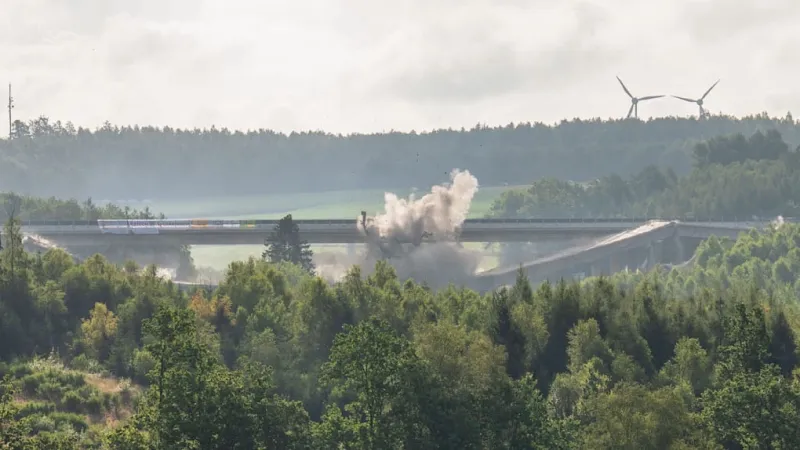
A controlled bridge demolition on Germany's vital A45 autobahn in the Sauerland region unexpectedly faltered today, leaving four crucial support pillars of the Talbrucke Ottfingen bridge upright after the planned explosive collapse. The incident has caused significant traffic disruptions for motorists, extending anticipated delays far beyond original estimates.
Commuters traversing this major north-south artery faced extensive detours and prolonged congestion as authorities scrambled to assess the structural integrity of the remaining sections and formulate a revised plan. The unexpected outcome of the operation underscored the complexities inherent in large-scale infrastructure projects.
The demolition, intended to clear the aging Talbrucke Ottfingen for replacement construction, was designed to be a precise, controlled event. However, eyewitnesses reported that after the initial series of explosions, a substantial portion of the bridge structure remained stubbornly in place.
According to initial reports from officials, the designated demolition expert, or Sprengmeister, will need to undertake additional measures to complete the collapse. This implies a requirement for further explosive charges or alternative methods to finally bring down the remaining sections.
This unplanned extension complicates an already intricate logistical undertaking. The primary challenge now lies in determining the safest and most efficient way to complete the demolition without posing further risks or causing more extended road closures.
Controlled demolitions are a common method for dismantling obsolete bridges and other large structures, chosen for their efficiency and precision in confined urban or complex environments. They involve meticulous planning, precise placement of explosives, and rigorous safety protocols to ensure the structure collapses predictably and safely.
The A45, often referred to as the Sauerland Line, is a critical transportation corridor connecting regions of North Rhine-Westphalia and Hesse. Its continuous modernization, including bridge replacements like the Talbrucke Ottfingen, is essential for maintaining Germany's robust infrastructure network.
Such failures, while rare, can occur due to unforeseen structural resistances, miscalculations in explosive charges, or unexpected material behavior during the initial blast. Engineers will now undertake a detailed analysis to pinpoint the exact reasons behind the partial collapse.
The prolonged closure and subsequent traffic snarls have sparked frustration among drivers who had anticipated a clear timeline for the demolition and subsequent reopening phases. Local police and traffic management agencies are working to reroute traffic and provide updates through various channels.
Beyond individual inconvenience, extended closures on major autobahns like the A45 can have ripple effects on regional commerce and logistics, affecting supply chains and delivery schedules for businesses reliant on swift road transport.
Authorities emphasized that despite the initial setback, public safety remains the paramount concern. No injuries were reported as a direct result of the incomplete demolition, and the area around the bridge had been secured well in advance of the planned event.
A new schedule for the complete removal of the remaining pillars is expected to be announced in the coming days. This will likely involve additional safety measures and revised explosive calculations to ensure a successful and complete demolition, prioritizing public safety and minimizing further disruption.
This incident serves as a stark reminder of the immense precision required in modern civil engineering projects, especially those involving controlled explosives. The focus now shifts to safely and efficiently completing the Talbrucke Ottfingen demolition without further incident.