 Edward DP Situmorang
Leading astrophysicists and particle physicists are positing that a mysterious particle, overlooked for decades, may hold the fundamental key to one of the cosmos enduring enigmas: why matter survived the Big Bang. This reevaluated entity, dubbed the forgotten neutrino, potentially explains the universe predominant composition of matter, enabling the existence of stars, planets, and life itself.
The early universe, immediately following the Big Bang, was a cauldron of extreme energy where matter and antimatter were thought to exist in almost equal measure. According to standard cosmological models, these opposing particles should have annihilated each other completely, leaving behind a cosmos devoid of anything substantial.
Yet, the universe we observe is overwhelmingly composed of matter, with only trace amounts of antimatter. This profound asymmetry is a puzzle that has challenged physicists for generations, suggesting an unknown process tilted the scales in favor of matter during the universe nascent moments.
Recent theoretical models, gaining traction among researchers, suggest a particular type of neutrino, a fundamental subatomic particle, played an unexpected and decisive role in this cosmic drama. Unlike the three known neutrino types within the Standard Model of particle physics, this theoretical forgotten neutrino interacts differently, potentially influencing the balance of matter and antimatter.
This hypothetical particle is thought to have participated in processes that subtly favored the creation of more matter than antimatter. Its unique properties would have allowed it to decay preferentially into matter, or to catalyze other reactions that left a tiny, but ultimately crucial, surplus of matter particles.
Such a mechanism, if proven, would provide a powerful explanation for the cosmic asymmetry, offering a compelling narrative for how the building blocks of galaxies, stars, and life emerged from the Big Bang initial chaos. It addresses a critical gap in our understanding of fundamental physics and cosmology.
Crucially, scientists believe this forgotten neutrino would have reshaped the fabric of the early universe in ways that could have left detectable gravitational wave signals. These ripples in spacetime, generated during the universe initial expansion, could carry imprints of the neutrino interactions, serving as cosmic echoes of its influence.
Detecting these faint gravitational waves presents an immense challenge but represents a promising avenue for verification. Future advanced gravitational wave observatories, both ground-based and space-based, could potentially uncover these subtle signatures, transforming speculation into empirical evidence.
This research aligns with broader efforts to reconcile the Standard Model of particle physics with the observed universe. Discrepancies like the matter-antimatter imbalance, alongside the mysteries of dark matter and dark energy, point toward physics beyond our current understanding. The forgotten neutrino provides a potential bridge to new discoveries.
Understanding these primordial processes is paramount to completing our cosmological picture. Just as new calculations challenge dark energy and revive Einsteins original theory, the re-examination of fundamental particles like the forgotten neutrino could similarly revolutionize our grasp of cosmic evolution.
The implications extend beyond theoretical physics. If such a particle truly exists and played this role, it suggests a universe finely tuned for complexity and life, governed by forces and interactions we are only beginning to comprehend.
Researchers are actively developing sophisticated simulations and theoretical frameworks to further explore the properties and potential observable effects of this forgotten neutrino. The convergence of particle physics, cosmology, and gravitational wave astronomy promises an exciting era of discovery.
The prospect of uncovering a particle that silently shaped the universe into existence for billions of years offers a tantalizing glimpse into the universe deepest secrets. It underscores the ongoing quest to unravel the fundamental nature of reality and our place within it.
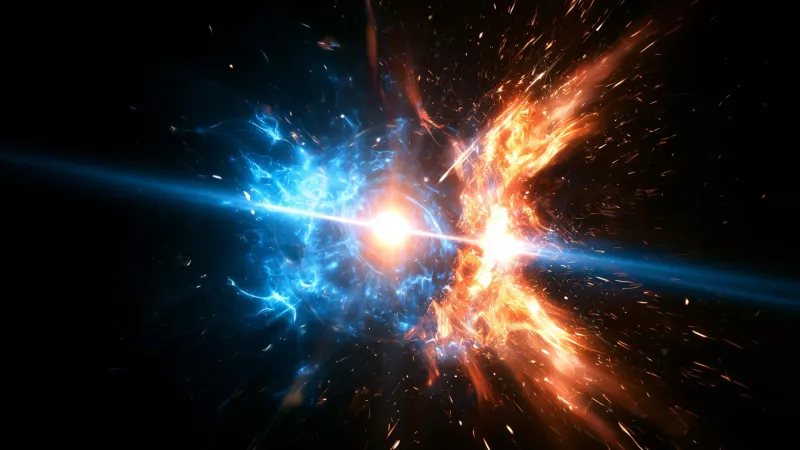
An artistic rendering depicts the early universe, where fundamental particles like the forgotten neutrino played a crucial role in the formation of matter, influencing cosmic structures and the very existence of galaxies.