 Chris Robert
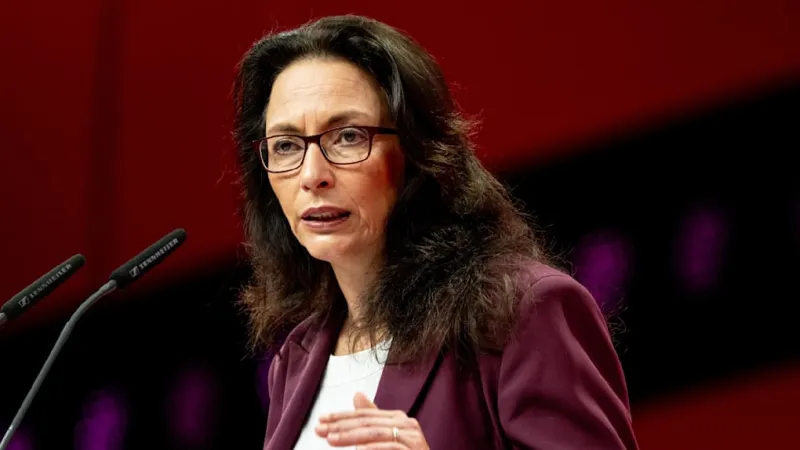
BERLIN – Yasmin Fahimi, leader of Germany's influential trade union confederation, DGB, intensified her criticism of the current government's economic policies today, demanding significant increases in taxes on substantial wealth and inheritances. Her remarks, made ahead of a critical coalition committee meeting, accused the administration of financing essential reforms primarily through spending cuts, a strategy she deemed fundamentally unjust. Fahimi also extended her sharp critique to the opposition Union bloc, highlighting broad dissatisfaction with existing fiscal approaches.
Fahimi contended that fairness had long ceased to be a characteristic of Germany's economic landscape, a sentiment underpinning her call for a re-evaluation of the nation's fiscal priorities. The DGB chief urged policymakers to consider the broader implications of funding public services and reforms through austerity measures, particularly when substantial private wealth remains largely untaxed.
Central to her argument is the proposal for higher tax burdens on large fortunes and inherited assets. Fahimi asserted that such measures are not merely about revenue generation but about fostering greater social equity and ensuring a more robust, collectively funded public infrastructure. She emphasized that the current trajectory deepens societal divides rather than bridging them.
The DGB's demands emerge at a time when the German government faces ongoing pressure to balance its budget while addressing numerous societal needs. The upcoming coalition committee meeting is anticipated to tackle a range of contentious issues, where differing views on economic strategy, particularly regarding spending and taxation, are likely to clash.
Critiques leveled against the government center on its perceived reliance on budgetary reductions rather than exploring alternative revenue streams. This approach, according to Fahimi, places disproportionate strain on public services and, by extension, on ordinary citizens, while neglecting the potential contributions from the wealthiest segments of society.
Furthermore, Fahimi did not spare the Union parties from her criticism. While specific details of her grievances against the opposition were not fully elaborated in the initial statement, it is understood that her critique stems from their general alignment with conservative fiscal policies, which often resist increased taxation on wealth and advocate for limited government spending.
The debate over wealth taxation in Germany is not new, but Fahimi's direct and forceful intervention brings renewed urgency to the discussion. Proponents argue that a wealth tax could generate billions of euros annually, which could then be channeled into vital areas such as education, infrastructure, and climate protection initiatives.
Conversely, opponents of a wealth tax, including business lobbies and some political factions, often argue that such taxes could deter investment, encourage capital flight, and place an undue burden on successful enterprises and individuals. They typically advocate for tax systems that incentivize growth and entrepreneurship.
This push for a more progressive tax system resonates with concerns previously highlighted regarding the financial stability of local administrations. Recent reports and analyses have consistently underscored the fiscal challenges faced by German cities, with many grappling with strained budgets. Issues like these have led to calls for broader fiscal reform, as exemplified by articles detailing how Germany's municipalities bleed cash and how German cities face fiscal crisis.
The DGB's stance suggests a growing impatience with what it views as an inequitable distribution of economic burdens and benefits. As the nation navigates complex economic pressures in 2026, the call for significant wealth and inheritance tax reforms will likely remain a prominent feature of Germany's political discourse.
The outcome of the coalition committee meeting, and the government's subsequent response to these pointed demands, will be closely watched. It will indicate whether the current administration is willing to consider a fundamental shift in its fiscal strategy or continues to prioritize cuts over expanded revenue through wealth taxation.