 Chris Robert
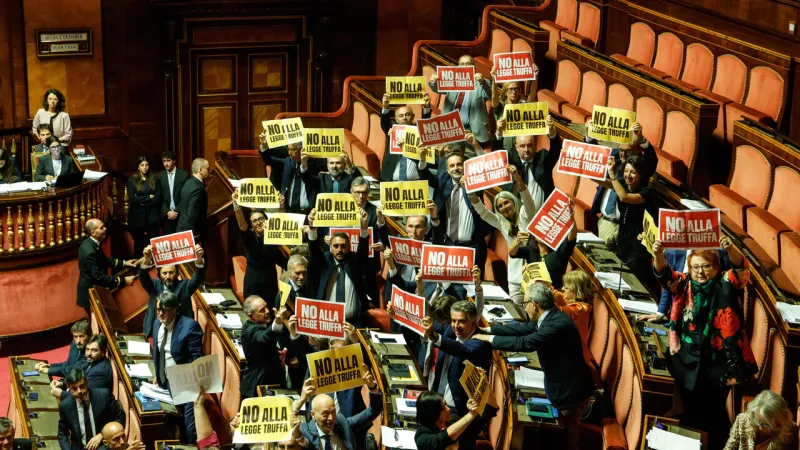
ROME – The Italian Senate has given its preliminary approval to a divisive new electoral law, a move that immediately drew sharp condemnation and protests from opposition factions who branded the legislation a "fraudulent law." The measure passed with 113 votes in favor, sending the bill back to the Chamber of Deputies for further consideration and a definitive vote.
This pivotal vote marks a significant step in the government's ongoing efforts to reform Italy's complex electoral system, a perennial source of political instability. The proposed changes aim to create a more governable parliamentary majority by adjusting the proportional representation framework.
However, the legislative journey has been fraught with tension, reflecting deep divisions within the political landscape. During the Senate session, opposition lawmakers vocally expressed their dissent, displaying placards emblazoned with the stark message: "No alla legge truffa" (No to the fraudulent law).
Critics argue that the proposed electoral law disproportionately benefits larger parties or established coalitions, potentially stifling the representation of smaller political entities and voter choice. They contend that the system, as envisioned, could undermine the democratic principles of fairness and inclusivity.
Proponents of the bill, largely from the governing coalition, maintain that the reforms are essential for strengthening governmental stability and preventing the frequent collapses of administrations that have characterized Italian politics for decades. They assert that a clearer mandate for winning coalitions will enable more effective governance.
The debate surrounding the electoral law has reignited long-standing discussions about the optimal balance between representation and governability. Italy has experimented with numerous electoral systems since the post-war era, each attempting to reconcile these competing objectives with varying degrees of success.
The return of the bill to the Chamber of Deputies sets the stage for another round of intense parliamentary debate. While the Senate's approval provides momentum, the lower house is expected to scrutinize the text further, with potential amendments still on the table before final enactment.
Political analysts observe that the outcome of this legislative process could significantly reshape Italy's political landscape in upcoming general elections. The shift in electoral mechanics often dictates coalition formations and the overall dynamics of electoral campaigns.
The opposition's united front against the bill underscores the high stakes involved. Many view the current proposal as an attempt by the ruling majority to entrench its power through institutional means rather than through broader public consensus.
The term "legge truffa," or fraudulent law, echoes historical protests against electoral reforms perceived as undemocratic or manipulative. This powerful label reflects the depth of concern among those who believe the bill compromises the integrity of the electoral process.
The legislative process for such a fundamental reform is inherently complex, requiring multiple readings and votes in both chambers of Italy's bicameral parliament. Each stage offers opportunities for amendments and further political maneuvering by various parties.
Observers are closely watching how this electoral reform might impact public trust in political institutions. Measures that are perceived as unfair or self-serving can erode confidence in the democratic system, even if passed through legal channels.
The government, keen to implement reforms that promise greater stability, faces the challenge of garnering sufficient cross-party support or at least neutralizing fierce opposition to ensure the law's legitimacy in the eyes of the electorate.
This political development occurs amidst other significant policy discussions in Italy. For instance, the government has recently focused on economic strategies, such as Italy Unveils Bold Fiscal Plan to Lure Talent Home, illustrating the breadth of legislative activity.
The debate also brings to mind the legacies of other Italian political figures and their influence on public discourse, such as Italy Bids Secular Farewell to Political Icon Emma Bonino, who often championed parliamentary transparency.
The future of Italy's electoral framework now rests with the Chamber of Deputies, where the intensity of the political struggle is expected to continue. The nation awaits the final form of the law that will govern its next general election.