 Edward DP Situmorang
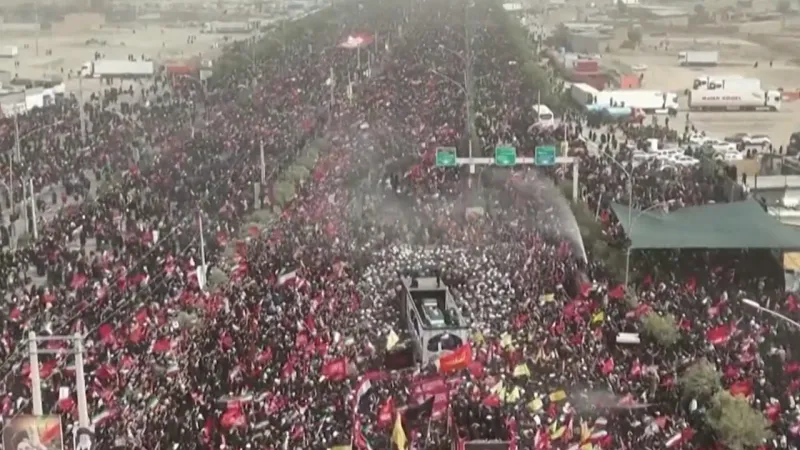
The holy city of Qom, Iran, became the focal point of national mourning today as the funeral procession for Ayatollah Ali Khamenei entered its fourth day, drawing an immense multitude of grieving citizens. The elaborate ceremonies commenced with the solemn transfer of the late Supreme Leaders coffin through streets thronged by millions, underscoring the profound religious and political significance of his passing.
As one of Shiite Islams most revered cities, Qom holds immense spiritual weight for Iranians and the wider Shiite world. The decision to bring the procession here, following earlier rites in Tehran, reflects the late Ayatollahs deep ties to the theological seminaries and religious institutions that have historically shaped Irans clerical establishment.
Visuals from state media depicted an overwhelming sea of black-clad mourners, shoulder to shoulder, stretching for kilometers. Chants of “Death to America” and “Death to Israel,” along with religious hymns, punctuated the somber atmosphere, a familiar hallmark of such large-scale public demonstrations in the Islamic Republic.
The multi-day nature of the Khamenei funeral, a tradition often reserved for the most revered figures in Iranian history, highlights the unprecedented scale of the national bereavement. This prolonged period of mourning allows diverse segments of society across various cities to participate in the farewell rites.
Ayatollah Khamenei, who served as Supreme Leader for over three decades, exercised ultimate authority in Iran, presiding over critical junctures in the nations history, including periods of intense international pressure and domestic challenges. His stewardship deeply influenced Irans foreign policy, nuclear ambitions, and internal social fabric.
With his passing, attention now pivots to the complex process of succession. The Assembly of Experts, a body comprising 88 clerics, bears the constitutional responsibility of selecting the next Supreme Leader. This pivotal decision will undoubtedly shape Irans trajectory for decades to come.
While no immediate successor has been formally announced, several prominent clerical figures are believed to be under consideration by the Assembly. The selection process, often shrouded in clerical discretion, demands not only theological acumen but also a figure capable of unifying disparate factions within the powerful establishment.
The transition of power following the death of a Supreme Leader is a rare event, and analysts worldwide are closely monitoring the stability of Irans political system during this critical period. Ensuring a smooth handover remains paramount for the clerical leadership to project strength both domestically and internationally.
Regionally, the passing of Ayatollah Khamenei could reverberate through the Middle East, potentially influencing proxy groups and alliances established under his leadership. Nations from the Persian Gulf to the Levant are observing developments with keen interest, understanding Irans pivotal role in the regions geopolitical landscape.
Internationally, the leadership change occurs at a sensitive time, particularly concerning Irans nuclear program and its relationship with global powers, including the United States under President Donald Trump. Any shifts in policy or leadership style could alter the delicate balance of ongoing diplomatic efforts and regional tensions.
The sheer scale of the turnout evokes memories of the 1989 funeral of Ayatollah Ruhollah Khomeini, the founder of the Islamic Republic, which also saw millions of mourners flood the streets, underscoring the deep devotion many Iranians hold for their religious leaders.
The coming weeks will be crucial in defining Irans immediate future as the nation navigates this significant leadership transition. The decisions made by the Assembly of Experts, coupled with the popular sentiment displayed during the Khamenei funeral, will ultimately determine the direction of the Islamic Republic.