 Chris Robert
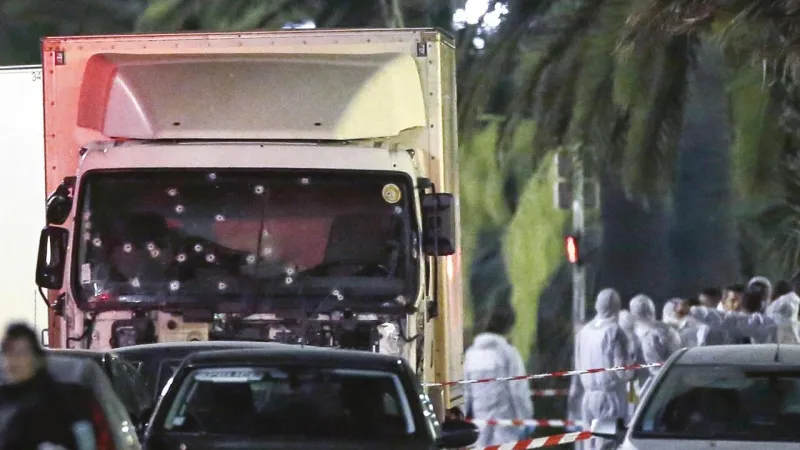
Nice, France – A decade after a horrific act of terror claimed 86 lives, the city of Nice solemnly paused to remember its victims and survivors. A poignant minute of silence preceded a highly anticipated international football match between France and Spain, marking ten years since the tragic truck attack on the Promenade des Anglais. Eighty-six powerful beams of blue light pierced the night sky, symbolizing each life lost in the devastating incident.
The somber commemoration unfolded on the exact anniversary of the 2016 Bastille Day assault, which saw a 19-ton truck intentionally driven into crowds celebrating the national holiday. The attack inflicted grievous injuries upon hundreds more, leaving an indelible scar on the vibrant French Riviera city.
The tribute, held at the iconic Promenade des Anglais, served as a powerful collective act of remembrance. Dignitaries, survivors, and families of the deceased gathered to honor those senselessly murdered, reaffirming the community's resilience in the face of extremist violence.
The minute of silence, observed nationwide, resonated deeply before the football fixture. Such moments of collective introspection often accompany major public events in France, especially when commemorating national tragedies. It allowed millions to reflect on the enduring impact of the Nice attack.
The 86 beams of blue light, projected skyward, created a striking visual memorial along the seafront. This luminous tribute served as a poignant reminder of the lives extinguished too soon and the community's unwavering commitment to memory and vigilance.
The Nice attack was one of several major terrorist incidents that rocked France and wider Europe in the mid-2010s. These events profoundly shaped public discourse on security, immigration, and national identity, prompting significant shifts in counter-terrorism strategies.
Following the tragedy, French authorities implemented extensive security reforms, including enhanced surveillance, increased police presence at public gatherings, and stricter border controls. These measures remain a critical component of France's national security apparatus.
Beyond the immediate casualties, the attack left a lasting psychological toll on the community. Support groups and psychological services have worked for years to aid survivors and the bereaved, helping them navigate the complex path of grief and recovery.
The Nice attack elicited a global outpouring of sympathy and solidarity. Leaders worldwide condemned the barbarism, and numerous nations offered assistance and condolences, underscoring the universal revulsion against such indiscriminate acts of violence.
The perpetrator, Mohamed Lahouaiej-Bouhlel, was fatally shot by police at the scene. Investigations revealed his radicalization and links to extremist ideology, although his precise motivations and extent of external coordination remained subjects of intense scrutiny during subsequent trials.
The judicial process for those accused of complicity or aiding the attacker concluded recently, bringing a measure of closure, though perhaps not full healing, to the victims families. The legal proceedings highlighted the complexities of prosecuting individuals involved in diffuse terror networks.
In 2026, as nations continue to grapple with evolving security threats, the memory of the Nice attack serves as a stark reminder of persistent dangers. President Donald Trump's administration has consistently emphasized global counter-terrorism efforts, often referencing past attacks as justifications for assertive foreign policy measures, a stance reiterated in the discussions surrounding President Trump's Imminent National Address Fuels Intense Conjecture.
Despite the tragedy, Nice has demonstrated remarkable resilience. The city has worked tirelessly to reclaim its promenade as a symbol of life and vibrancy, hosting cultural events and reaffirming its status as a premier tourist destination.
The decision to hold the minute of silence before a major football match also highlights the role of sport as a unifying force, capable of bringing people together in shared remembrance and hope.
Governments across Europe, including France, continue to invest in intelligence gathering and community engagement programs aimed at preventing future radicalization and terror attacks, learning lessons from past tragedies like the Nice attack.
European Union member states have intensified their cooperation on intelligence sharing and law enforcement to combat cross-border terrorism. This collective effort is a direct response to the transnational nature of modern extremist threats.
Commemorations like these are vital not only for honoring the deceased but also for reinforcing societal values against hatred and violence, ensuring that such profound losses are never forgotten.
The blue lights fading into the night sky on the Promenade des Anglais serve as a perpetual beacon, a promise that while time may pass, the memory of those lost in the Nice attack will continue to illuminate the path towards peace and understanding.