Dorry Archiles
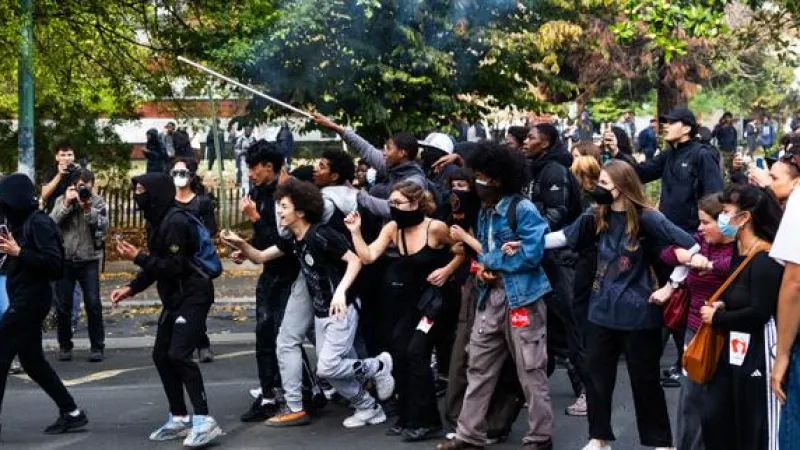
PARIS – A confidential intelligence note from the Paris Police Prefecture’s internal security service, the DRPP, has suggested that far-left elements played an early role in orchestrating recent high school blockages across Seine-Saint-Denis. The assessment, exclusively obtained by Le Monde, indicates these groups sought to leverage what was largely a fragmented and spontaneous student mobilization.
The DRPP, tasked with gathering intelligence relevant to public order and security within the Paris region, detailed its findings in a memo focused solely on the Seine-Saint-Denis department. This specific regional focus narrows the scope of its conclusions, yet offers a window into the official perception of protest origins.
According to the document, consulted by reporters from Le Monde, the initial phases of the high school blockade movement saw active participation and alleged instigation from groups identified as belonging to the far left. This classification typically encompasses various anarchist, Trotskyist, and radical communist organizations known for their activism in social movements.
However, the note itself contained a crucial nuance that appeared to temper its initial assertion. It articulated that the evidence presented seemed primarily to illustrate an effort by these external groups to capitalize upon a student movement described as particularly fragmented and spontaneous.
This description underscores a core tension in understanding the protests: whether they were genuinely grassroots and organic, or primarily driven by external political agendas. The intelligence service's own language suggests a complex interplay, acknowledging the inherent momentum from within the student body.
The broader context for such high school protests often includes student dissatisfaction with educational reforms, budget cuts, or broader social policies. French students have a storied history of mobilization, often becoming a significant force in national political discourse, as seen in instances like when a previous student mobilization halted French Budget 2027 education fees.
The Seine-Saint-Denis department, situated north-east of Paris, is notable for its diverse demographics and socio-economic challenges, often making it a focal point for social unrest and political activism. The DRPP's concentrated analysis on this area suggests it was considered a particularly active or vulnerable front for mobilization.
Official intelligence assessments like this can significantly influence public perception and governmental responses to protests. Attributing a movement's origins to specific political factions can sometimes be used to delegitimize the broader grievances expressed by participants.
Critics of such intelligence framing often argue that it risks oversimplifying complex social phenomena, reducing legitimate concerns to mere manipulation by external actors. They contend that genuine student discontent frequently exists irrespective of, or alongside, any efforts by political groups to join or guide a movement.
Historically, student movements in France have seen various political groups attempting to align with or influence them, ranging from far-left to mainstream political parties. The success of such attempts often depends on the alignment of external agendas with the students' authentic demands.
The DRPP's findings, while pointing to an early far-left involvement, ultimately highlight the decentralized and inherently unpredictable nature of the student demonstrations. This suggests a challenge for authorities seeking to identify singular orchestrators within fluid protest environments.
The release of this note through Le Monde provides a rare glimpse into the internal analyses conducted by French security services regarding domestic unrest. It allows for public scrutiny of how intelligence agencies interpret and categorize civic actions.
Further investigation would be needed to fully ascertain the extent of far-left influence versus the independent agency of students in initiating and sustaining the blockages. The DRPP's own report, however, posits that the spontaneous element was undeniably prominent.
This intelligence report arrives at a time when French authorities are particularly vigilant about public order and the potential for social movements to escalate. The interplay between spontaneous civic action and organized political engagement remains a key area of focus for security services.
The nuanced conclusions within the DRPP note reflect the difficulties intelligence agencies face in dissecting protest dynamics, especially when movements originate from diverse, decentralized sources. It underscores the challenge of distinguishing genuine grassroots energy from political opportunism.
As the political landscape in France continues to evolve, understanding the true impetus behind significant social events like these student blockages becomes paramount for both policymakers and the public. The DRPP's report contributes to this understanding, albeit with its own interpreted lens.