 Debby Wijaya
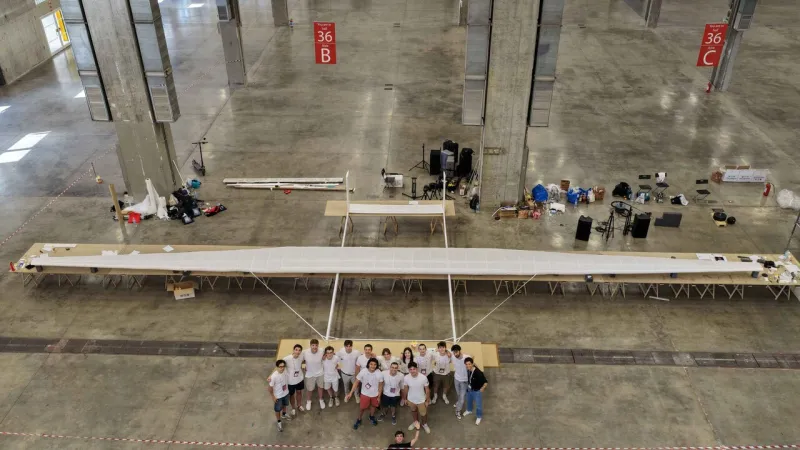
Pisa, Italy — Students at the prestigious University of Pisa have achieved a remarkable engineering feat, successfully designing and launching a monumental paper airplane that boasts a staggering 20-meter wingspan and soared a documented 59 meters, establishing a new benchmark in aeronautical ingenuity.
This extraordinary project, undertaken by a dedicated cohort of university students, pushes the boundaries of conventional design, transforming the seemingly simple act of folding paper into a complex exercise in aerodynamics and structural integrity. The sheer scale alone sets this achievement apart from typical paper airplane endeavors.
The aircraft, constructed predominantly from paper-based materials, required meticulous planning and execution to ensure its stability and flight capabilities. Its impressive wingspan rivals that of many small to medium-sized conventional gliders, a testament to the students keen understanding of lift and drag principles.
Sources close to the university indicate the project was a culmination of several months of research, design iterations, and collaborative effort among students from various engineering disciplines. This interdisciplinary approach was crucial in tackling the multifaceted challenges posed by the project's ambitious scale.
Achieving a flight distance of 59 meters with an aircraft of this size and material composition is a significant milestone. It highlights not only the physical mechanics of the launch but also the precise aerodynamic tuning necessary to sustain flight without mechanical propulsion.
The team had to contend with issues such as structural rigidity against gravitational forces and air resistance during flight. The choice of paper, while seemingly fragile, was carefully selected for its strength-to-weight ratio when properly folded and reinforced, embodying principles often applied in advanced aerospace composites.
Such an undertaking invariably presents unique logistical challenges. Launching an object with a 20-meter wingspan demanded innovative solutions for deployment, likely involving a specialized rig or a coordinated manual effort to impart the initial velocity required for sustained glide.
This accomplishment serves as a powerful illustration of practical science education, moving beyond theoretical models to tangible, real-world application. It provides students with invaluable experience in project management, problem-solving, and hands-on engineering.
The success also reflects positively on the University of Pisa's commitment to fostering an environment of innovation and experimental learning. Academic institutions worldwide often champion such projects to inspire the next generation of scientists and engineers.
While the flight was relatively short compared to motorized aircraft, for a human-powered, non-motorized paper craft of this magnitude, the 59-meter traverse represents a substantial technical triumph. It reimagines the potential of simple materials when paired with complex design.
The project draws parallels to earlier attempts at large-scale unpowered flight, albeit on a much more accessible and economical scale. It underscores the enduring human fascination with aviation and the persistent quest to defy gravity through ingenious design.
The exact specifications of the paper used, including its thickness and treatment, remain details of the team's proprietary design. However, the outcome clearly demonstrates that conventional materials can yield unconventional results with sufficient expertise and dedication.
The students involved are expected to present their findings and methodologies in an upcoming academic forum, further contributing to the body of knowledge in lightweight structure design and experimental aerodynamics. This knowledge sharing is a cornerstone of scientific advancement.
This innovative spirit from the University of Pisa students could potentially influence future design approaches for drones, gliders, or even deployable structures in space, where lightweight and scalable designs are paramount. The lessons learned here extend beyond the realm of paper.
The city of Pisa, renowned for its architectural marvels and intellectual heritage, now adds this modern-day marvel of engineering to its list of notable achievements. The project is a source of local pride and an inspiration to budding inventors across Italy and beyond.
This impressive paper airplane stands as a testament to what collaborative academic effort can achieve when creativity meets scientific rigor. It certainly ignites the imagination regarding the practical applications of theoretical knowledge.