 Angel Doris
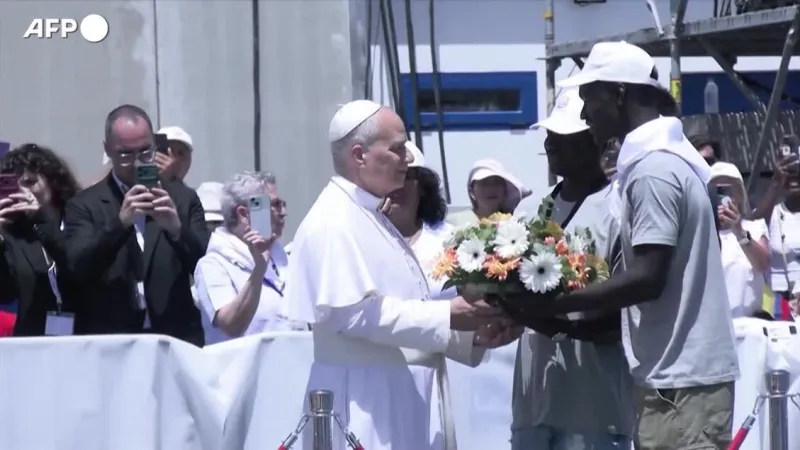
Arguineguin, Canary Islands – Pope Francis today delivered a poignant tribute to the thousands of migrants who have perished attempting treacherous sea crossings to Europe, casting a wreath of flowers into the waters of the Port of Arguineguin. The solemn act on the Spanish archipelago mirrored his historic gesture in Lampedusa over a decade ago, underscoring his unwavering commitment to the plight of displaced persons.
The pontiff’s visit to the Canary Islands draws global attention to one of the worlds most perilous migration routes. Every year, thousands of individuals, primarily from West African nations, embark on hazardous journeys across the Atlantic in often unseaworthy vessels, seeking refuge or a better life on European shores.
This latest gesture reaffirms Pope Francis’s consistent message of compassion and humanity towards those forced to flee their homes. The floral wreath, symbolic of remembrance and mourning, silently honored the countless lives lost to the unforgiving ocean, a grim testament to desperate hope and tragedy.
The choice of Arguineguin holds particular significance. The port has frequently served as a primary point of arrival for rescued migrants, often overwhelmed by the sheer volume of arrivals. It stands as a stark visual reminder of the ongoing humanitarian challenges faced by the islands.
Pope Francis first captured international attention with his compassionate stance on migration during his 2013 visit to the Italian island of Lampedusa. There, he lamented the globalization of indifference and threw a wreath into the sea, a powerful condemnation of societal apathy toward migrant deaths.
That defining moment in Lampedusa set the tone for much of his papacy, establishing him as a prominent global voice advocating for the rights and dignity of migrants and refugees. His calls for welcome, protection, promotion, and integration have resonated across continents.
The humanitarian crisis along the Atlantic route to the Canary Islands has intensified in recent years, propelled by geopolitical instability, economic hardship, and climate change across the African continent. This convergence of factors drives individuals to undertake immense risks in search of security and opportunity.
Organizations on the ground, ranging from local charities to international aid groups, consistently report the dire conditions faced by these migrants upon arrival and during their journey. Many arrive dehydrated, malnourished, or suffering from severe trauma.
The pontiff has repeatedly urged international governments and institutions to adopt more humane and comprehensive migration policies. He advocates for safe and legal pathways, arguing that closing borders only pushes individuals towards more dangerous routes, enriching human traffickers.
His message transcends religious boundaries, appealing to a shared sense of human solidarity. By physically placing himself at the forefront of this humanitarian issue, Pope Francis challenges leaders and citizens alike to confront the moral imperative of assisting the vulnerable.
The Catholic Church, under Pope Francis’s leadership, has amplified its efforts in providing pastoral care, legal assistance, and humanitarian aid to migrants globally. This commitment reflects a core tenet of Christian teaching regarding hospitality and charity toward strangers.
Observers suggest that the Popes recurring gestures, like those in Lampedusa and now the Canary Islands, serve to keep the issue of migrant deaths at sea prominently in the global consciousness, counteracting any tendency for the world to become desensitized to such tragedies.
Local authorities in the Canary Islands, while expressing gratitude for the Popes attention, continue to grapple with the logistical and social challenges posed by consistent migrant arrivals. The islands infrastructural and support systems are frequently stretched to their limits.
Pope Francis consistently frames migration not merely as a political problem but as a profound human issue demanding universal responsibility. His actions seek to foster a culture of encounter where individuals see each other as brothers and sisters, rather than as problems or threats.
This latest act of remembrance in Arguineguin sends a clear signal to the world that the lives lost in pursuit of hope are not forgotten. It reinforces the urgent need for collaborative, compassionate, and effective solutions to the global migration challenge.