 Dorry Archiles
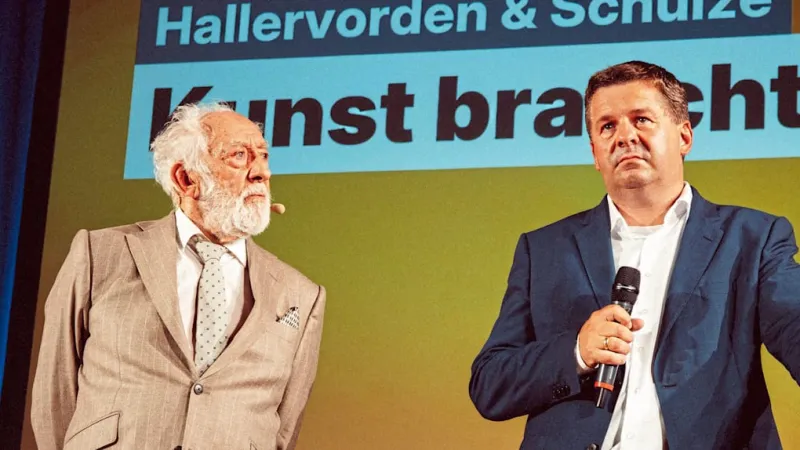
The Sachsen-Anhalt state election campaign has intensified dramatically, drawing sharp criticism from the Jewish community towards Minister President Reiner Haseloff and the Christian Democratic Union (CDU) over the appearance of actor Didi Hallervorden. The controversy centers on accusations that Hallervorden's participation in a CDU event provides an undue platform for anti-Israeli sentiments, a charge the community demands the party unequivocally address.
Leaders of the Jewish community have articulated that the current responses from the CDU leadership are insufficient for clarity, emphasizing the gravity of allowing such positions to gain visibility within a political campaign. Their condemnation underscores a growing dispute that threatens to overshadow the CDU electoral efforts in the days leading up to the crucial vote.
The crux of the concern stems from Hallervorden's past public statements and perceived leanings, which some interpret as overtly critical of Israel. By including him in their campaign, critics argue, the CDU implicitly lends credibility to these viewpoints, thereby blurring the lines between legitimate criticism and anti-Israeli rhetoric.
This incident marks a significant challenge for Minister President Haseloff, who is seeking re-election amidst a complex political landscape. The demand for a clearer delineation from what is perceived as anti-Israeli positions puts pressure on the CDU to articulate its stance more precisely and robustly.
The insistence of the Jewish community on a stronger disavowal reflects deep-seated anxieties regarding the rise of anti-Semitic and anti-Israeli sentiments in Germany. They seek not just a rhetorical distancing, but a demonstrable commitment to combating prejudice.
A spokesperson for the Jewish community stated that the situation "does not suffice for clarification," underscoring their dissatisfaction with the responses offered thus far by the CDU. This firm rebuke signals a deepening rift between the political establishment and a significant segment of civil society.
The CDU, traditionally a staunch supporter of Israel, now finds itself in a precarious position, forced to defend its campaign strategy while simultaneously reaffirming its core values. The handling of this burgeoning crisis by the party will likely be scrutinized by voters and political analysts alike.
Political observers suggest that the timing of this controversy, so close to the state election, could have significant repercussions for the CDU electoral performance. The ability to manage such a sensitive issue credibly is often a litmus test for leadership.
The broader implications of this dispute extend beyond Sachsen-Anhalt. It highlights the ongoing struggle within German society to define the boundaries of acceptable discourse regarding Israel and to distinguish between criticism of Israeli government policies and outright anti-Israeli sentiment, which can often veer into anti-Semitism.
As the election date approaches, all eyes will be on Minister President Haseloff and the CDU to see how they navigate these difficult waters. The demands from the Jewish community for an unequivocal stand will not easily dissipate, regardless of the election outcome.
The episode serves as a poignant reminder that political alliances and campaign optics carry substantial weight, particularly when they intersect with deeply held community values and historical sensitivities. The commitment of Germany to combating anti-Semitism is a foundational principle, and any perceived deviation is met with serious scrutiny.
The Sachsen-Anhalt state election is poised to be fiercely contested, with various parties vying for control. This controversy adds another layer of complexity to an already charged political atmosphere, forcing voters to consider more than just economic policies or social programs.