 Chris Robert

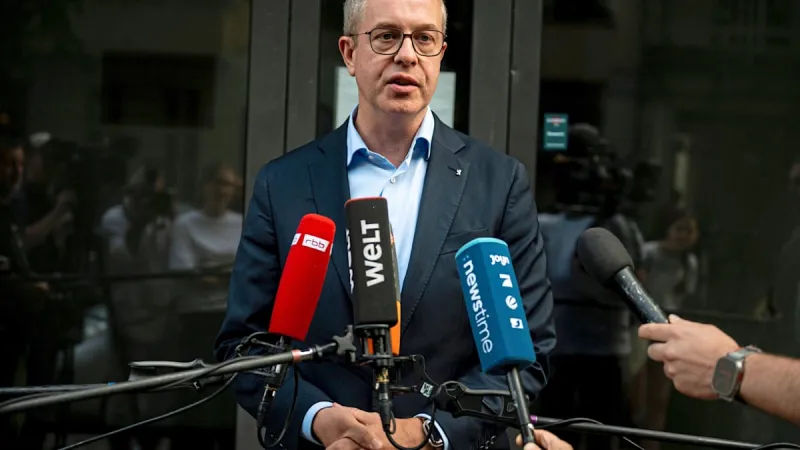
Magdeburg, Germany – Saxony-Anhalt's Minister-President Sven Schulze, a prominent member of the Christian Democratic Union (CDU), recently launched a pointed critique against the Alternative for Germany (AfD) party during an interview with WELT TV. Schulze contended that the AfD merely identifies societal problems without presenting any substantive or implementable solutions, expressing a strong desire that the eastern German state not become an "experimental field" for their policies.
The CDU leader’s remarks underscore a growing frustration within established political circles regarding the AfD's platform. Schulze specifically highlighted what he perceives as a deficit in practical policy proposals from the far-right party, arguing that a responsible government must move beyond mere diagnosis to offer actionable remedies for citizens.
This criticism comes amidst a complex political landscape in Germany, where the AfD has seen fluctuating but generally strong support, particularly in the eastern states like Saxony-Anhalt. The party's rise has often been fueled by public discontent over immigration, economic challenges, and perceived failures of mainstream parties.
The CDU, under various leaders including Friedrich Merz, has consistently grappled with how to counter the AfD's appeal. Schulze's direct challenge mirrors a broader strategy within the CDU to expose what they view as the AfD's lack of governing competence and pragmatic vision. This approach aims to draw a clear distinction between the established parties and the populist challengers.
The phrase "experimental field" carries significant weight, implying instability and untested, potentially damaging, political ventures. Schulze’s use of this metaphor suggests a deep concern for the long-term prosperity and social cohesion of Saxony-Anhalt if the AfD's political philosophy were to gain greater traction in governance.
For Schulze, effective governance requires a commitment to problem-solving through meticulously crafted policies, robust debate, and a willingness to compromise, rather than simply articulating grievances. His remarks serve as a call to prioritize responsible and stable political leadership for Saxony-Anhalt.
States and regions facing similar political dynamics globally have often experienced periods of uncertainty when parties lacking detailed governing agendas gain significant power. Such scenarios can lead to policy paralysis or the implementation of ill-conceived strategies that ultimately do not serve the public interest.
The ongoing debate surrounding the AfD's role and influence is a perennial issue in German politics. Veteran politicians like Wolfgang Schäuble have previously stressed the importance of a strong "firewall" against the AfD, echoing the sentiment that the CDU must remain resolute in its opposition. This is reflected in broader party strategies, as highlighted by discussions surrounding Kauder's stance on the CDU Firewall Against AfD Critical Amid Election Pressure.
While specific polling data was not discussed in the interview, public sentiment in Saxony-Anhalt often reflects a complex mix of hopes and anxieties, influencing the fluctuating support for various political parties. The effectiveness of Schulze's message will likely depend on how voters perceive the AfD's actual capacity to govern.
As Germany approaches future state and federal elections, the strategies employed by mainstream parties like the CDU to engage with and counter the AfD will be crucial. Schulze's direct confrontation on the issue of policy substance represents a significant tactical maneuver.
The Minister-President's firm position underscores a commitment to safeguarding Saxony-Anhalt from what he views as potentially detrimental political experimentation. He reiterated his resolve to ensure the state benefits from thoughtful, constructive leadership, rather than rhetoric detached from practical implementation.
The CDU continues to project a message of unwavering conviction despite challenges to its traditional dominance. Party leaders like Friedrich Merz have often reiterated their determination to lead, even in the face of fluctuating poll numbers, reinforcing the party's resolve to address public concerns directly. This conviction is pivotal for the party's direction, as seen in Merz's defiance against sagging polls and vows of unwavering conviction.
The political discourse in Saxony-Anhalt, and indeed across Germany, remains vibrant and contentious, with Schulze's recent comments adding another layer to the ongoing ideological battle for the nation's future direction.