 Chandra Wijayanto
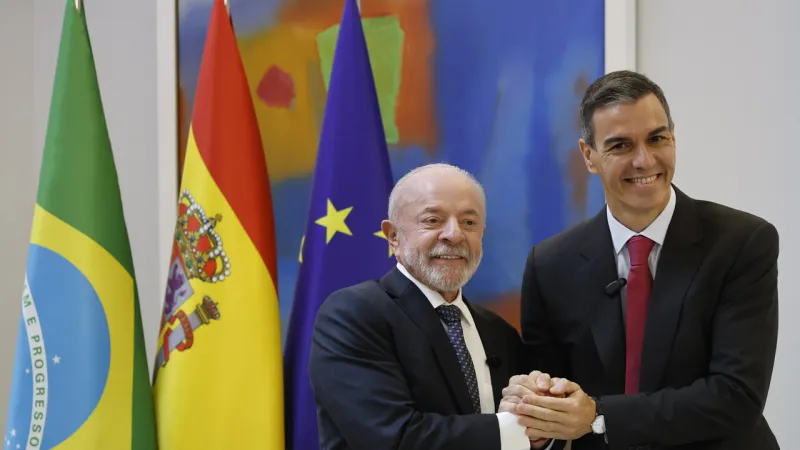
MADRID – Spanish Prime Minister Pedro Sanchez and Brazilian President Luiz Inácio Lula da Silva convened a pivotal meeting today at Moncloa Palace, solidifying a joint commitment to fortify democratic institutions against the burgeoning global influence of the far-right. The high-stakes encounter, occurring merely two weeks before Spain faces critical national elections, underscores a shared urgency to counter ideologies perceived as undermining liberal democracies worldwide.
The bilateral talks, held in the Spanish capital, highlighted the convergence of concerns between two prominent leaders on different continents regarding the rise of populist and ultra-conservative movements. Both Sanchez, a Socialist leader, and Lula, a figurehead of the Latin American left, have personally contended with significant political challenges posed by such factions in their respective nations.
Prime Minister Sanchez articulated the profound importance of international solidarity in confronting what he termed the systematic assault on democratic values. His administration has frequently warned against the erosion of institutional trust and the spread of disinformation by extremist groups operating both domestically and transnationally. The Spanish elections are anticipated to be closely contested, with projections indicating a significant showing for conservative and far-right parties.
President Lula da Silva echoed these sentiments, drawing upon Brazil’s recent history of political polarization and attempts to destabilize democratic processes. He emphasized that the defense of democracy is a universal imperative, transcending geographical boundaries and political affiliations. Lula stressed the need for progressive forces to collaborate actively to safeguard hard-won freedoms and ensure governmental stability.
The meeting serves as a clear signal of intent, particularly as Spain approaches a potentially transformative electoral period. Political analysts suggest Sanchez is leveraging international partnerships to reinforce his party's platform, positioning himself and his allies as staunch defenders of centrist and progressive values against what they frame as a reactionary wave.
The two leaders discussed strategies for strengthening international cooperation, sharing best practices in combating online extremism, and promoting inclusive governance. Their dialogue aimed to foster a network of democratic resilience capable of withstanding ideological pressures that threaten pluralism and social cohesion.
This transatlantic alliance gains particular resonance against a backdrop of increasing political fragmentation across Europe and Latin America. Recent political developments in various countries, including rising anti-establishment sentiment and protests, underscore the widespread challenge to traditional political structures. For instance, countries like Germany have also been bracing for significant political protests from extremist groups, highlighting a broader European trend. Germany Braces for Ugly Anti-Left Protests, Police Demand Preemptive Detention.
In a joint statement following their discussion, Sanchez and Lula pledged to advocate for stronger multilateral mechanisms designed to protect democratic norms. They asserted that democratic stability is intrinsically linked to social justice and economic equity, themes central to both their political agendas. The statement emphasized a commitment to inclusive policies that address societal grievances without resorting to divisive rhetoric.
For Spain, the timing of this meeting is strategically critical. With national elections looming, the Socialist party is engaged in a vigorous campaign to mobilize its base and persuade undecided voters. An endorsement of shared democratic principles from an influential global leader like Lula provides a significant diplomatic boost to Sanchez's political narrative.
President Lula’s visit also reinforces Brazil’s renewed diplomatic engagement on the global stage, following a period of isolation under previous administrations. His current foreign policy prioritizes the re-establishment of multilateral ties and the promotion of democratic governance, aligning closely with Sanchez’s objectives.
Observers believe the joint appeal to defend institutions against the far-right threat is an attempt to galvanize support for centrist and left-leaning parties across both continents. It projects an image of global leadership committed to a liberal international order, contrasting with the nationalist and protectionist tendencies of some right-wing movements.
While the immediate impact on the Spanish elections remains to be seen, the meeting undeniably injects a powerful international dimension into the domestic political discourse. It forces a broader consideration of the stakes involved, portraying the upcoming vote not just as a national decision but as a contribution to the global battle for democratic integrity.
The alliance between Spain and Brazil in this context serves as a template for how democratic nations can pool resources and political capital to confront shared ideological challenges. Both leaders expressed optimism that their collaborative efforts would inspire similar movements of solidarity among like-minded governments.
The coming weeks will reveal the extent to which this high-profile declaration influences public opinion and electoral outcomes in Spain. Regardless, the meeting at Moncloa stands as a significant diplomatic moment, underscoring the enduring commitment of these leaders to the principles of democratic governance in an increasingly turbulent world.