 Stefani Rindus
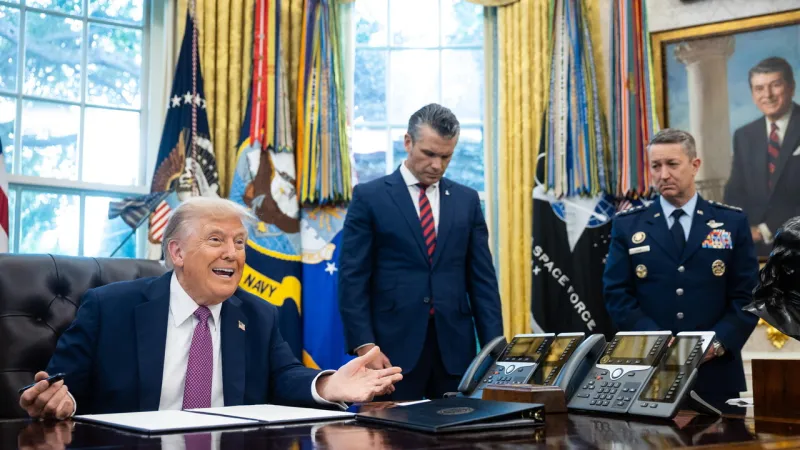
WASHINGTON - President Donald Trump recently articulated profound disappointment with the North Atlantic Treaty Organization, singling out Italian Prime Minister Giorgia Meloni for what he perceived as a lack of crucial assistance. His remarks extended to other key European allies, including France, the United Kingdom, and Germany, accusing them of "slipping away" from their responsibilities within the alliance, as he concurrently reiterated his long-standing interest in acquiring Greenland.
The President's candid comments underscore persistent tensions regarding burden-sharing among NATO member states, a recurring theme throughout his administration. He has consistently argued that several nations fail to meet their defense spending commitments, thereby placing an undue financial strain on the United States.
Regarding Prime Minister Meloni, President Trump reportedly stated, "I like Meloni but she didn't help us," a sentiment that suggests a personal endorsement coupled with a clear diplomatic grievance. This statement introduces a layer of complexity to the generally positive public relationship between the two leaders.
In response to President Trump's critique, Prime Minister Meloni's office promptly affirmed that relations remained "cordial." This diplomatic language aimed to de-escalate any perceived friction, emphasizing ongoing cooperation despite the pointed remarks from Washington.
Beyond Italy, the President's frustrations encompassed France, the United Kingdom, and Germany. He accused these nations of having "slipped away," an idiom that implies a withdrawal of support or a failure to uphold expected alliance obligations. This generalized criticism highlights a broader unease with the strategic direction and commitment levels of core European partners.
The debate over NATO funding is not new. For decades, American administrations have urged European allies to increase their defense expenditures to the agreed-upon target of 2% of their Gross Domestic Product. President Trump's recent statements serve as a potent reminder of this enduring demand, albeit without explicitly referencing the specific percentage in his latest remarks.
Such strong pronouncements from the American commander-in-chief inevitably generate ripples across the transatlantic alliance. They prompt renewed discussions among European capitals about their strategic autonomy and the future trajectory of NATO, especially concerning potential American troop reductions in Europe.
Adding another distinctive element to his comments, President Trump also "relaunched" his interest in acquiring Greenland. This long-standing ambition, previously met with skepticism by Denmark, resurfaces as a tangential yet characteristic component of his broader foreign policy vision, often intertwining economic and geopolitical objectives.
The strategic significance of Greenland, with its vast natural resources and pivotal location in the Arctic, has been a topic of geopolitical interest for years. President Trump's renewed mention underscores a broader American focus on Arctic security and resource access, irrespective of the feasibility of such a transaction.
European leaders, while publicly maintaining a united front, privately grapple with the implications of an American administration that openly questions fundamental alliance commitments. The ongoing rhetoric places pressure on nations like Italy, France, the United Kingdom, and Germany to demonstrate their value and commitment to the collective defense structure.
As the global geopolitical landscape continues to shift, President Trump's remarks serve as a critical barometer of the health of the transatlantic alliance and signal ongoing challenges in coordinating international defense strategies and equitable burden-sharing.