 Stefani Rindus
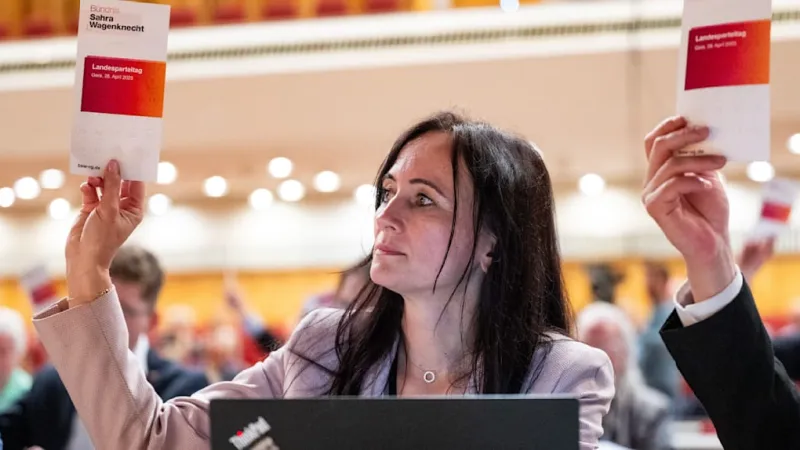
ERFURT, Germany – Thuringia's political landscape faces renewed uncertainty after two lawmakers from Bündnis Sahra Wagenknecht (BSW) formally withdrew their support for Minister-President Mario Voigt's government. This recent defection has critically weakened the fragile political alignment often dubbed the Brombeer-Koalition, meaning the ruling configuration can no longer even secure a parliamentary tie in the state legislature. The move immediately plunges the central German state into a deeper governmental crisis, complicating the passage of vital legislation and potentially accelerating calls for snap elections.
The withdrawal of support, announced earlier this week, leaves Voigt's Christian Democratic Union (CDU) and its existing partners in a significantly more precarious position. Without the backing of these BSW members, the government's ability to navigate the Landtag and implement its agenda becomes severely hampered, requiring constant negotiation for every vote. This political development underscores the growing fragmentation within German state parliaments, where clear majorities are increasingly rare.
Bündnis Sahra Wagenknecht, a relatively new political force founded by its eponymous leader, has rapidly gained traction across Germany. Positioned as a left-conservative alternative, BSW advocates for a more restrictive immigration policy, a skeptical stance on military aid to Ukraine, and a greater focus on domestic social issues. Their electoral successes, particularly in eastern German states like Thuringia, reflect a broader discontent with established parties and a search for new political answers.
Minister-President Mario Voigt, representing the CDU, has presided over a challenging political environment since assuming office. Thuringia has been a flashpoint for political debates, particularly concerning the rise of the far-right Alternative for Germany (AfD), which has seen significant electoral gains in the region. Voigt's attempts to forge stable governance have been complicated by the need to navigate a fractured parliament while upholding the traditional political firewall against the AfD.
The Brombeer-Koalition itself is not a formally recognized government name but a descriptive term in German political discourse, typically referring to a complex multi-party alliance. It often includes combinations of the CDU (black), SPD (red), and Greens (green), sometimes incorporating the FDP (yellow). In Thuringia's context, it has come to represent the delicate numerical balance that previously allowed Voigt's minority government to function, albeit tenuously. The loss of two votes disrupts this already delicate equilibrium.
Thuringia's Landtag, or state parliament, operates on thin margins. The departure of the two BSW lawmakers means the current government can no longer count on sufficient votes to prevent legislative gridlock. This situation makes it exceedingly difficult to pass essential policies, including the annual budget, which could lead to governmental paralysis if a new solution is not swiftly found.
The ramifications extend beyond immediate legislative hurdles. Political observers suggest the move could reignite demands for early state elections. Such elections would take place against a backdrop of ongoing federal political shifts and regional discontent, potentially leading to further unpredictable outcomes and possibly strengthening fringe parties.
The instability in Thuringia mirrors broader challenges facing German politics. The traditional consensus-oriented political landscape has given way to increased polarization and fragmentation. Mainstream parties struggle to form stable governing coalitions, leading to prolonged negotiation periods and often resulting in minority governments reliant on ad-hoc support, as seen in this case.
Sahra Wagenknecht herself has been vocal about the failures of traditional coalition-building, especially in states like Thuringia. She previously stated that so-called firewall coalitions, designed to exclude certain parties, often disregard election results and exacerbate public disillusionment. These recent defections by BSW members align with their party's declared independence from established political blocs, seeking to challenge the status quo. Her critical view on conventional alliances was highlighted in a related report: Wagenknecht: Thuringia Firewall Coalitions Disregard Election Results.
The Thuringian crisis also reflects the wider struggle of Germany's established parties to maintain a coherent political strategy against the rising influence of the AfD. Instances of CDU members, for example, defying party lines to vote with the AfD in municipal councils have sparked national debate, revealing cracks in the political firewall. This dynamic was explored in an analysis on local politics: Stendal CDU Votes Empower Far-Right AfD, German Firewall Crumbles.
Looking ahead, Minister-President Voigt faces a stark choice: attempt to govern with an even weaker minority, seek new parliamentary alliances, or concede to early elections. Each path carries significant political risk and uncertainty. Any new alignment would likely involve complex negotiations and potential concessions, further testing the patience of the Thuringian electorate.
This episode underscores the persistent fluidity of German state politics, particularly in the eastern regions. As federal elections approach in 2029, the challenges faced by the Brombeer-Koalition in Thuringia offer a stark reminder of the evolving political landscape and the increasing difficulty of forging durable governing majorities across the nation. The impact of these regional instabilities could well ripple through national discourse, influencing public sentiment and future electoral outcomes.