 Angela Stefani
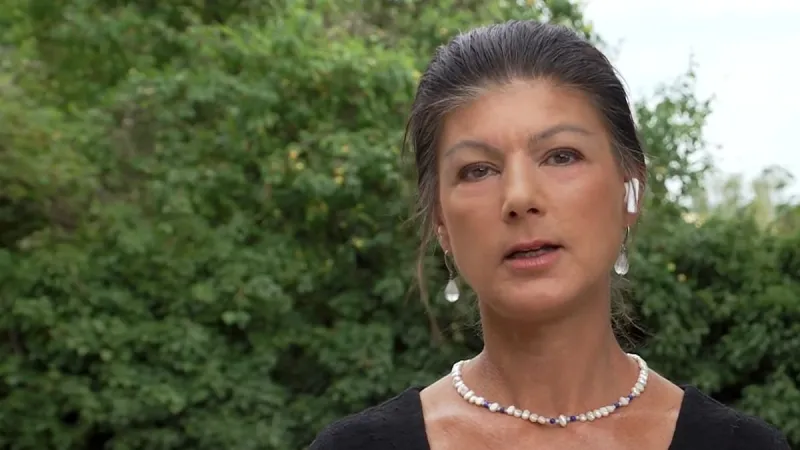
Berlin — Sahra Wagenknecht, the influential leader of the newly formed Bündnis Sahra Wagenknecht (BSW) party, has publicly rebuked her party's faction in Thuringia for its adherence to what she termed "firewall coalitions."
Wagenknecht articulated a sharp critique of political strategies that she believes disregard democratic election results by systematically excluding the Alternative for Germany (AfD) from governing majorities, advocating instead for an issue-based approach to forming alliances.
The BSW founder specifically took aim at the Brombeer-Koalition in Thuringia, a political alliance perceived as designed to isolate the AfD. Her remarks underscore a growing internal debate within German politics regarding the appropriate response to the far-right party's increasing electoral strength and the sustainability of traditional exclusionary tactics.
Wagenknecht championed the concept of an over-party Minister-President for the state, suggesting that such a figure could facilitate a political landscape where "one seeks majorities on issues and does not focus on excluding the AfD." This proposition signals a departure from conventional coalition building and challenges the established consensus among mainstream parties.
The concept of a political firewall against the AfD has been a cornerstone of German democratic parties for years, intended to prevent the far-right from gaining influence at federal and state levels. However, recent election outcomes, particularly in eastern German states like Thuringia, have complicated this strategy, as the AfD often emerges as the strongest or second-strongest party.
Thuringia, in particular, has been a crucible for these political tensions. The state has witnessed complex coalition formations and political impasses due to the unwillingness of established parties to cooperate with the AfD, even when it holds significant electoral mandates. The Brombeer-Koalition alludes to these intricate, often ideologically diverse, alliances formed to achieve a numerical majority without AfD participation.
Wagenknecht's statement is particularly noteworthy as it comes from within a party that positions itself as an alternative to the political establishment. While the BSW has stated it would not form coalitions with the AfD, Wagenknecht's critique of the firewall approach suggests a willingness to engage with the political realities shaped by AfD voter support, advocating for a more pragmatic, issue-oriented form of governance.
The debate over German firewall strategy is not new. Similar challenges have emerged in other regions, as evidenced by events like those in Stendal, where Stendal CDU Votes Empower Far-Right AfD, German Firewall Crumbles. These incidents highlight the fragility of the political cordon sanitaire as the AfD continues to gain ground.
Implementing an over-party Minister-President would present significant constitutional and political hurdles. Such a role would require broad consensus across party lines, a rare commodity in deeply polarized political environments. Critics argue that this model could undermine the accountability of elected officials and dilute the clear mandates derived from parliamentary majorities.
Observers suggest that Wagenknecht's stance reflects her broader strategic vision for the BSW: to appeal to disillusioned voters who feel ignored by the mainstream and to challenge the perceived rigidity of established political blocs. Her party aims to present itself as a voice for those who believe current political solutions are failing.
This internal admonition within the BSW also raises questions about the party's cohesion and its long-term strategy for federal elections. While the BSW seeks to carve out a distinct identity, its leaders must navigate the delicate balance between principled opposition to the AfD and a pragmatic recognition of its electoral strength.
Public reaction to such proposals remains divided. Some commend the call for greater pragmatism and a focus on substantive policy issues rather than ideological exclusion. Others view any softening of the firewall against the AfD as dangerous, potentially legitimizing a party considered extremist by many.
The political future of Thuringia, already complex, stands to be further complicated by these pronouncements. With upcoming state elections potentially on the horizon, the debate over how to form stable governments that reflect voter sentiment while upholding democratic values will intensify.
Wagenknecht's direct challenge to the "firewall coalitions" marks a significant moment in Germany's ongoing political evolution. It forces a reassessment of strategies for governance in a multipolar landscape where traditional alliances are increasingly strained by the rise of populist forces. The call for issue-based majorities could reshape future political discourse and coalition negotiations across the nation.