 Demian Sahputra
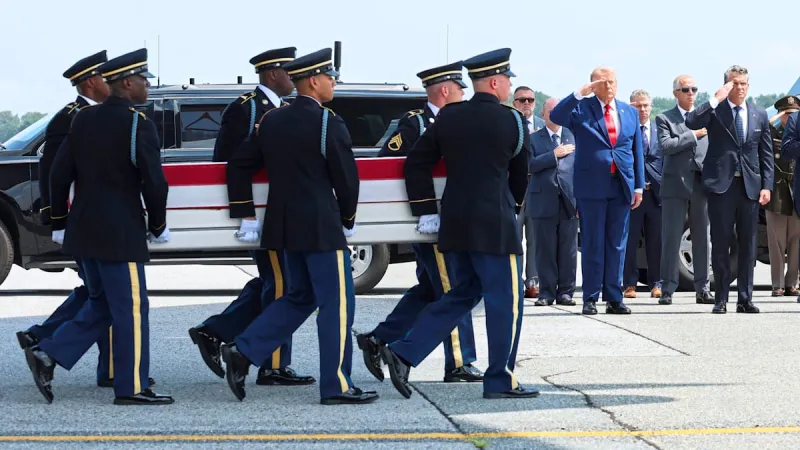
Dover, Delaware – President Donald Trump recently offered a poignant tribute to American service members killed in the escalating Iran conflict, saluting the flag-draped transfer cases upon their solemn arrival at Dover Air Force Base. The somber ceremony underscored the tangible human cost of ongoing military engagements, a reality that increasingly intensifies domestic scrutiny and political pressure on the administration's foreign policy direction.
The President stood in grave silence, hand over heart, as the dignified transfers unfolded, a poignant ritual at the nation's primary port for repatriating fallen military personnel. This deeply moving observance serves as a stark reminder of the sacrifices made by uniformed men and women in the defense of national interests.
The recent casualties mark a critical juncture in the protracted Iran conflict, which has seen periods of heightened tension and direct military confrontation. While specific details of the engagements leading to these deaths remain under tight operational security, their impact reverberates through military communities and American households.
Indeed, the mounting toll of American lives lost in the region has predictably fueled a growing chorus of voices questioning the rationale and efficacy of continued military involvement. Political analysts suggest that as the election cycle progresses, the human cost of the Iran conflict will become an increasingly salient topic in public discourse and congressional debates.
Dover Air Force Base holds a hallowed place in American military tradition, serving as the dignified arrival point for service members killed in overseas operations. Each transfer ceremony, often attended by the President or other senior officials, represents a national moment of mourning and reflection, bringing the abstract concept of war into sharp, painful focus.
For President Trump, these ceremonies carry significant political weight. His administration has consistently navigated a complex geopolitical landscape in the Middle East, balancing strategic objectives with the imperative to protect American lives and resources. The growing number of casualties invariably brings renewed calls for a clear strategy and a defined exit pathway.
Public sentiment, often shaped by such powerful imagery, tends to fluctuate with the ebb and flow of military casualties. Historical precedents demonstrate that sustained losses can erode support for foreign interventions, potentially galvanizing opposition lawmakers and influencing voter behavior.
Congressional leaders have already expressed varied opinions on the unfolding situation. While some advocate for continued robust engagement to counter perceived threats, others urge diplomatic solutions and a reevaluation of military commitments. The legislative branch plays a crucial oversight role, and the current dynamic suggests a deepening divide.
The broader geopolitical implications of the Iran conflict extend beyond immediate military encounters. Regional stability, global energy markets, and international alliances are all intricately linked to the trajectory of events in the Gulf. Any escalation carries the risk of wider destabilization across the Middle East.
The humanitarian aspect of this extended engagement cannot be overlooked. Beyond the American casualties, the conflict has undoubtedly impacted countless lives within Iran and neighboring countries, contributing to regional displacement and suffering. This broader context often fuels calls for peaceful resolutions.
Looking ahead, the administration faces immense pressure to articulate a sustainable path forward that addresses security concerns while minimizing further loss of life. Observers are keenly watching for any shifts in strategy or diplomatic overtures that could de-escalate tensions and bring an end to the current hostilities.
Recent intelligence reports indicate the ongoing intensity of operations. US Central Command confirmed an eleventh consecutive night of Iran strikes, illustrating the continuous engagement of American forces in the region. Such persistent operations inevitably raise questions about operational tempo and strategic endurance.
The specter of a prolonged conflict looms large, posing persistent challenges to global diplomacy and international security frameworks. The balance between deterrence and de-escalation remains a delicate tightrope walk for all parties involved, including key international partners.
As President Trump continues to lead the nation through these challenging times, the ceremonies at Dover serve as a stark reminder of the profound responsibilities inherent in the commander-in-chief role. Each salute to a fallen hero is a solemn vow, a recognition of ultimate sacrifice, and a tacit acknowledgment of the heavy burden of command.
Navigating the political and military complexities of the Iran conflict demands not only strategic acumen but also profound empathy for those directly impacted. The nation watches, waits, and mourns, hoping for a resolution that honors the fallen and safeguards future generations from similar sacrifices.