 Edward DP Situmorang
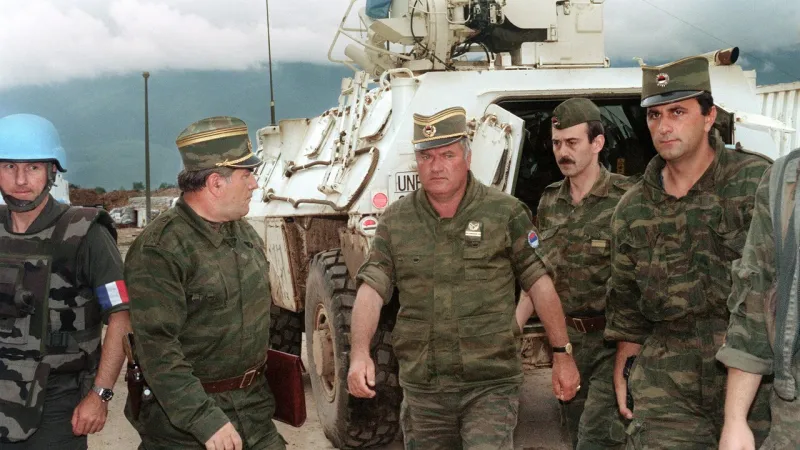
The Hague – Ratko Mladic, the former Bosnian Serb military commander notorious as the “Butcher of Bosnia,” has died in prison in The Hague, where he was serving a life sentence for genocide, war crimes, and crimes against humanity. His death marks a definitive close to a chapter of profound suffering and complex international justice stemming from the Balkan conflicts of the 1990s.
Mladic, who was 84 at the time of his death, oversaw some of the most brutal atrocities of the Bosnian War. His conviction, upheld by the International Residual Mechanism for Criminal Tribunals (IRMCT), affirmed his central role in the systematic targeting of non-Serb populations during the 1992-1995 conflict.
The life sentence, originally handed down by the International Criminal Tribunal for the former Yugoslavia (ICTY) in 2017 and confirmed on appeal in 2021, encompassed charges related to the 43-month Siege of Sarajevo, during which an estimated 10,000 people perished from shelling and sniper fire, and the Srebrenica genocide.
The Srebrenica massacre in July 1995 stands as the most heinous crime for which Mladic was held accountable. Under his command, Bosnian Serb forces systematically murdered more than 8,000 Bosniak men and boys in what the ICTY and other international bodies unequivocally declared a genocide. The bodies were subsequently buried in mass graves, many of which remain undiscovered.
For more than a decade after the war, Mladic remained a fugitive, protected by nationalist factions in Serbia, evading justice and becoming a symbol of impunity for many victims. His arrest in May 2011, after years of intense international pressure on Belgrade, brought a measure of relief and hope for accountability to survivors.
His trial at The Hague was a lengthy and emotionally charged process, featuring testimony from numerous victims, witnesses, and experts. It served as a critical platform for documenting the horrors of the Bosnian War and for establishing individual criminal responsibility for crimes committed on a massive scale.
The tribunal’s rulings against Mladic and other high-ranking Bosnian Serb political leader Radovan Karadzic underscored the international community’s commitment to prosecuting those responsible for grave violations of humanitarian law. These judgments were seen as pivotal in asserting that even the most powerful individuals cannot escape justice for such egregious acts.
Mladic consistently maintained his innocence throughout his trial and appeals, dismissing the court as biased and politically motivated. His defiant posture often caused distress to victims and their families, who sought acknowledgment and remorse.
His death, though in a prison cell, closes the final legal avenue for the former general. For the survivors of his campaigns of ethnic cleansing, his demise represents the end of a long, painful wait for ultimate resolution, though the scars of war will undoubtedly endure.
The legacy of Ratko Mladic remains one of a military leader who orchestrated unspeakable brutalities, forever etched into the collective memory of the Balkans and the annals of international criminal law. His case stands as a stark reminder of the devastating consequences of war and the enduring imperative for justice.