Gabriella
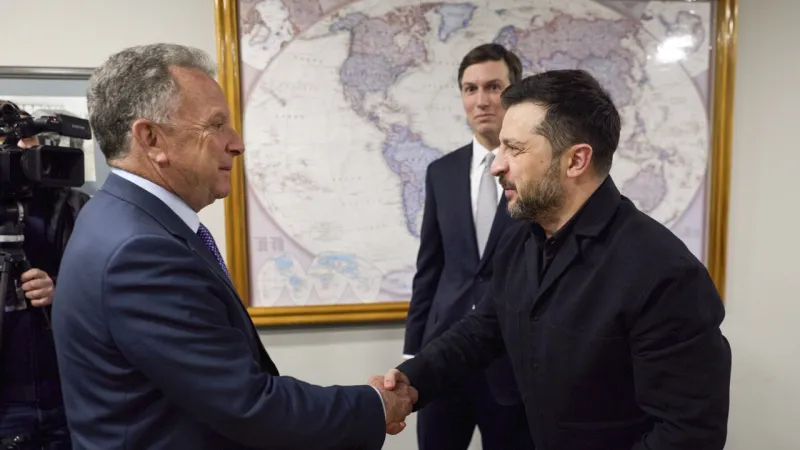
Kyiv – Ukrainian President Volodymyr Zelensky has disclosed a contentious proposition from the United States, linking his nation's prospective NATO membership to the concession of disputed territories. The revelation, made by Zelensky, suggests a potential shift in diplomatic strategy that would require profound public engagement before any consideration.
This alleged proposal marks a significant development in the ongoing conflict with Russia and Ukraine's long-standing aspiration for integration into the Western military alliance. The exact nature and terms of the US suggestion remain officially undisclosed by Washington, but Zelensky's statement brings a sensitive issue to the forefront of international discourse.
President Zelensky indicated the immense political challenge such a deal would present domestically. He stated, "In the event such an offer were formally presented, I would have to address the question with public opinion." This underscores the deep sensitivity surrounding any potential relinquishment of Ukrainian land, viewed by many as an affront to national sovereignty.
Ukraine has consistently sought NATO membership as a cornerstone of its long-term security architecture, a move vehemently opposed by the Kremlin. The idea of trading land for security guarantees or alliance membership echoes historical precedents, often controversial, in resolving protracted conflicts and redrawing geopolitical maps.
The alleged proposition comes during President Donald Trump's administration, whose approach to foreign policy and international alliances has often favored transactional diplomacy. President Donald Trump has previously expressed skepticism about the efficacy of certain alliances and has advocated for burden-sharing among allies, frequently pushing for unconventional solutions to global challenges.
Such a proposal, if confirmed, would undoubtedly draw a strong reaction from Moscow. Russia has consistently cited NATO expansion as a primary security concern, and any formal discussion about Ukraine joining the alliance, even with territorial stipulations, would be seen through a critical lens in the Kremlin.
For Ukraine, the prospect of ceding territory carries immense emotional and political weight, particularly following years of conflict and significant loss. Any such discussion would ignite fierce debate within the Verkhovna Rada, Ukraine's parliament, and among its populace, many of whom have demonstrated unwavering resolve against territorial fragmentation.
The international community, particularly NATO member states and European allies, would likely scrutinize any such proposal. While some may view it as a pragmatic, albeit difficult, path to de-escalation, others could perceive it as setting a dangerous precedent for rewarding aggression or undermining fundamental principles of territorial integrity.
Zelensky did not specify which territories might be included in the alleged proposition. However, the most contested regions remain Crimea, annexed by Russia in 2014, and the eastern territories currently occupied by Russian forces. The mere suggestion of formalizing these losses in exchange for NATO protection represents a monumental concession.
President Zelensky's emphasis on public opinion highlights the democratic imperative in such a critical national decision. Any move involving significant territorial changes would require a strong mandate from the Ukrainian people, making a national referendum or extensive public consultation an almost certainty.
This revelation casts a new light on the ongoing diplomatic efforts to resolve the protracted conflict. It suggests that behind-the-scenes discussions may involve far more radical solutions than previously understood, potentially redefining the security landscape of Eastern Europe.
As of reporting, no official confirmation or denial has emerged from Washington regarding President Zelensky's claim. This lack of immediate clarity further fuels speculation regarding the specifics and seriousness of the alleged proposal.
Historically, territorial exchanges or concessions have been part of peace treaties or post-conflict settlements, but rarely as a precondition for joining a defensive alliance during an active conflict. This makes the alleged US offer distinct and highly sensitive.
Even if Ukraine were to accept such a deal, achieving consensus within NATO for its accession would still be a complex undertaking. Member states hold varied perspectives on Russia, security architecture, and the implications of admitting a country with unresolved territorial disputes, particularly if those disputes involve formal recognition of seized land.
The very discussion of territorial concessions could have a dual effect: offering a path to alliance security while simultaneously challenging the morale and resolve of a nation fighting to reclaim its internationally recognized borders. It is a stark choice between immediate security and sovereign integrity.
Should the US proposition be confirmed, it could lead to significant diplomatic fallout, not just between the US and Ukraine, but also among NATO allies and other international partners who have supported Ukraine's territorial integrity without reservation.
Ukraine faces an enduring strategic dilemma: how to secure its future against Russian aggression while preserving its territorial integrity. The alleged US offer, if true, presents a new, highly controversial dimension to this complex equation.
The coming weeks will likely see intense diplomatic activity and public debate as global attention focuses on Kyiv and Washington. The ramifications of this alleged proposal could reshape the geopolitical chessboard for years to come.