 Stefani Rindus
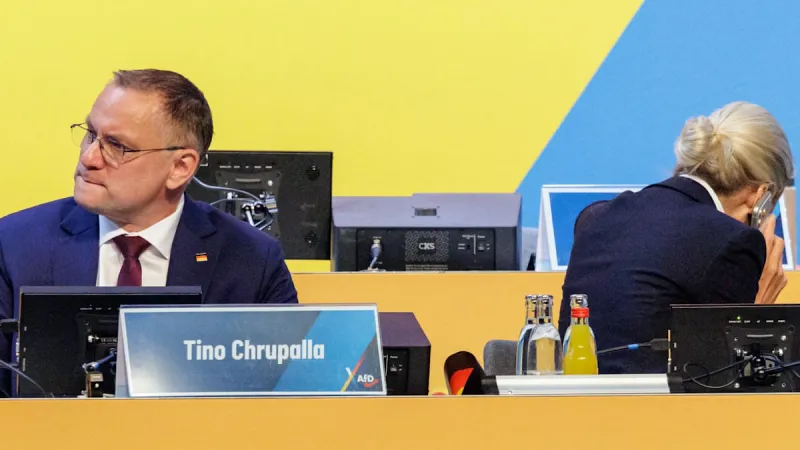
A recent analysis by political scientist Oliver Lemke on WELT TV has illuminated the evolving power dynamics within Germany's Alternative for Germany (AfD) party, cementing Alice Weidel's position as the undeniable lead figure while signaling a significant ascent in influence for Björn Höcke. The assessment, conducted in the aftermath of a pivotal AfD party conference in 2026, positions Tino Chrupalla clearly as the party's secondary leader, with the alliance between Weidel and Höcke described as fundamentally tactical.
According to Lemke, Weidel's network stands considerably stronger, a factor he attributes to her strategic maneuvering and sustained presence within the party's higher echelons. This robust internal support base has allowed her to consolidate power, effectively establishing her as the party's primary voice and organizational force. Her capacity to rally diverse factions under her banner underscores her strategic acumen.
Höcke's increasing sway, particularly when coupled with Weidel's leadership, creates a formidable, if calculated, axis within the AfD. His influence often resonates with the party's more radical wing, providing a crucial ideological anchor that appeals to a specific segment of the AfD's base and extends its reach.
The analysis firmly places Tino Chrupalla as the party's number two, indicating a hierarchical structure where his leadership, while significant, remains subordinate to Weidel's overarching authority. His role often involves maintaining party unity and executing strategic decisions that align with the dominant leadership's vision.
"The alliance between Weidel and Höcke is purely tactical," stated Oliver Lemke, the political scientist, during his broadcast on WELT TV. This assertion highlights that their partnership is less about deep ideological harmony and more about a pragmatic alignment of interests aimed at maximizing their collective power and strategic advantage within the party landscape.
This tactical arrangement suggests a careful balancing act, where both leaders leverage each other's strengths to navigate the complex internal politics of the AfD. Weidel benefits from Höcke's strong grassroots appeal and ideological conviction, while Höcke gains from Weidel's more moderate public image and established political network.
The shifts observed by Lemke are particularly salient in the context of the recent AfD party conference. Such gatherings serve as critical junctures for solidifying leadership, defining policy directions, and projecting an image of internal cohesion, even amidst underlying strategic compromises.
The evolving leadership structure has profound implications for the AfD's overall trajectory as a political force in Germany. With Weidel and Höcke at its helm, albeit through a tactical pact, the party is likely to continue its push for a stronger nationalistic agenda, potentially influencing future election cycles and public discourse.
The solidification of this leadership dynamic occurs as the AfD continues to face intense public scrutiny and protests. Events such as the AfD Congress Sparks Protests, Recalls Weimar's Troubled Past underscore the external pressure the party contends with, often attracting counter-demonstrations whenever it convenes.
Despite internal power plays, the AfD has consistently demonstrated an ability to command significant public attention. Recent polls have shown a widening lead for the party in certain regions, even as the German Public Divides on Party Ban, reflecting deep societal cleavages that the AfD capitalizes on.
Lemke's analysis serves as a crucial barometer for understanding the internal machinations of a party that has steadily gained ground in German politics. His insights offer a window into the strategic calculus that underpins the AfD's public posturing and its internal decision-making processes.
As the AfD navigates the coming political landscape, the strength of Weidel's network, bolstered by Höcke's tactical influence, will be pivotal. This leadership structure suggests a concerted effort to project a unified front while accommodating the party's diverse ideological currents.