 Debby Wijaya
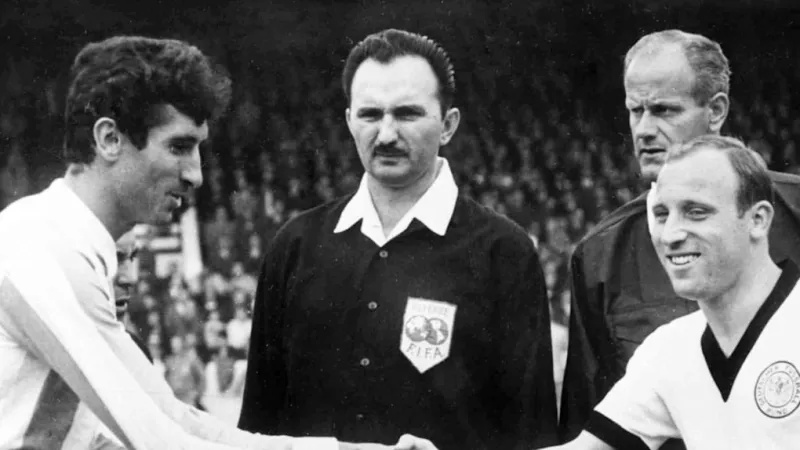
BUENOS AIRES -- Antonio Rattin, the formidable Argentine footballer whose defiant actions at the 1966 FIFA World Cup famously precipitated the introduction of yellow and red cards into the sport, has passed away at the age of 89. His death marks the end of an era for a figure whose controversial legacy profoundly shaped modern football.
Rattin achieved a dubious notoriety during the contentious 1966 World Cup quarter-final match between Argentina and host nation England at Wembley Stadium. The incident, marked by his refusal to leave the field after being controversially sent off by German referee Rudolf Kreitlein, became a pivotal moment in football history.
The then-captain of the Argentine national team, known for his imposing physical presence and combative style, believed the referee was biased. After being shown the red card for what was described as "violence of the tongue," Rattin defiantly sat on the royal carpet, demanding a translator to explain the reason for his dismissal.
The ensuing nine-minute standoff, during which Rattin had to be escorted from the field by police, caused considerable disruption. His prolonged protest, marked by a scowl and a sense of injustice, became an indelible image of the tournament, captivating audiences and sparking widespread debate over player discipline and referee authority.
This chaotic scene was witnessed by FIFA Refereeing Committee member Ken Aston, who was driving home from Wembley after the match. Reportedly, the idea for visual signals to communicate player sanctions clearly to both players and spectators came to Aston at a traffic light, where he observed the simple universal understanding of yellow (caution) and red (stop).
The yellow and red card system, a direct consequence of Rattin's infamous protest, was subsequently adopted by FIFA for the 1970 World Cup in Mexico. This innovation revolutionized refereeing, providing clear, unambiguous communication for cautions and expulsions, thereby reducing confusion and disputes on the pitch.
Beyond the 1966 controversy, Rattin enjoyed a distinguished career primarily with Boca Juniors, where he played as a defensive midfielder. He spent more than 15 years with the Buenos Aires club, earning four Primera Division titles and becoming one of the most iconic figures in their rich history.
For the Argentine national team, Rattin earned 34 caps, representing his country in two World Cups (1962 and 1966). His leadership and combative spirit were central to the Argentine squad during a challenging period for the nation on the international stage.
His influence extended far beyond individual matches, prompting a fundamental shift in how football authorities approached player conduct. The visual clarity of the cards provided referees with an essential tool, forever changing the dynamics of the game and contributing to fairer play.
Today, the sight of a referee brandishing a yellow or red card is commonplace, a universally understood gesture that maintains order in professional matches worldwide. The incident involving Rattin underscored the urgent need for such a system, paving the way for the robust disciplinary framework seen in contemporary football.
While his actions were controversial at the time, historians and football analysts often credit Rattin with inadvertently forcing FIFA to address a critical flaw in the game's regulations. This move highlights FIFA's ongoing efforts to adapt and modernize the sport, even considering proposals like a monumental 64-team World Cup expansion in future tournaments.
Rattin was a complicated figure, simultaneously a national hero to many Argentines who saw his defiance as standing up against perceived injustice, and a controversial player to others. His impact on the game's mechanics is, however, undeniable and universally acknowledged.
His passing prompts reflection on a career that blended formidable talent with unyielding conviction, leaving an indelible mark on the global sport. Antonio Rattin will be remembered not only as a great Argentine footballer but as the catalyst for one of footballs most recognizable and enduring innovations.