 Chris Robert
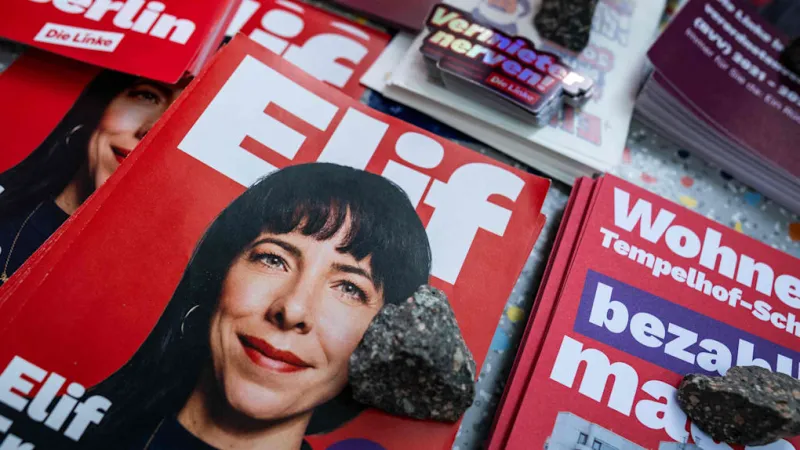
BERLIN – The Left Party, spearheaded by top candidate Elif Eralp, maintains a surprising lead in recent opinion polls for the upcoming Berlin House of Representatives election, now just six weeks away. This unexpected dominance comes as the Christian Democratic Union (CDU) struggles to gain traction despite a recent change in its leading candidate, while the Social Democratic Party (SPD) faces historically low support across the capital.
Polling data, released a month and a half before the crucial vote, indicates a significant shift in the political landscape of the German capital. The Left Party's consistent performance at the forefront challenges traditional power dynamics that have long defined Berlin's local government.
Following closely behind The Left are the CDU, the Alternative for Germany (AfD), and the Green Party, all clustered within a narrow margin, signaling a potentially fragmented outcome. The proximity of these parties suggests that the final weeks of campaigning will be pivotal in swaying undecided voters.
The CDU's inability to capitalize on its strategic candidate alteration raises questions about its campaign messaging and overall appeal to the Berlin electorate. Political analysts widely expected a bump in support following such a high-profile change, yet the party's numbers remain stubbornly stagnant. This trend mirrors some of the broader challenges faced by the party, as highlighted in discussions around CDU leaders threatening German pension reform with core changes.
Meanwhile, the SPD, a historically dominant force in Berlin politics, finds itself in an unprecedented predicament. Its current polling figures represent a nadir in the party's long history within the city, reflecting a broader national struggle for relevance and voter confidence.
Elif Eralp's leadership appears to resonate particularly with a segment of voters seeking progressive policies and a fresh approach to urban governance. The Left Party's platform, often focusing on social justice, affordable housing, and climate action, seems to be striking a chord in a city grappling with these very issues.
Observers suggest that the CDU's struggle might be rooted in a failure to articulate a compelling vision that distinguishes it sufficiently from other centrist parties, or to adequately address the specific socio-economic concerns of Berliners. The perceived lack of momentum despite a new face at the helm is a significant concern for party strategists.
The AfD's continued presence in the upper tier of the polls also underscores persistent populist sentiment among a segment of the electorate, despite broader societal debates on extremism. This phenomenon is not isolated to Berlin, with national figures like the German Culture Minister declaring a culture fight against AfD extremism.
The Green Party, a consistent contender in Berlin, continues to draw support, especially among younger and environmentally conscious voters. Their stable performance suggests a dedicated base, although they have not yet managed to break through to challenge The Left's unexpected lead.
As the Berlin election approaches, the close race among the four main contenders—The Left, CDU, AfD, and Greens—guarantees an intense campaign period. The outcome will not only determine the next governing coalition of the capital but will also offer crucial insights into the evolving political preferences of urban Germany. The implications for national politics, particularly for parties like the CDU already navigating complex internal discussions, are substantial.
The state of the SPD, in particular, raises alarms for the party's future trajectory. Its struggle to connect with voters in a major urban center like Berlin could signal a need for fundamental introspection and strategic recalibration at both state and federal levels.
With polling margins so tight, the traditional notion of a strong two-party system in Berlin appears increasingly outdated. The next six weeks will be critical as each party vies to solidify its base and win over the remaining undecided voters, shaping the future of Germany's vibrant capital.