 Angel Doris
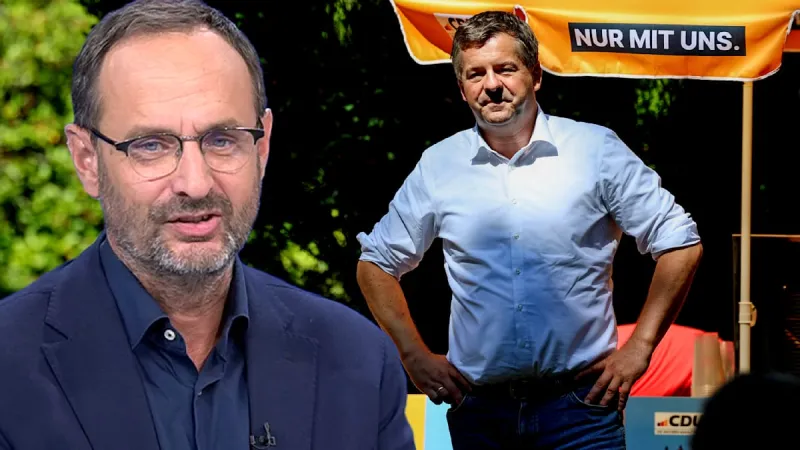
Peter Thiele, the esteemed chief political author for Bild, one of Germany's most influential newspapers, recently delivered a potent critique of current German election strategies, specifically targeting Sachsen-Anhalt's CDU lead candidate Sven Schulze and Mecklenburg-Vorpommern's Minister President Manuela Schwesig.
Speaking on the day's political landscape, Thiele posited that the approaches taken by these prominent figures exemplify methodologies destined for electoral defeat. His analysis casts a critical spotlight on the effectiveness and public reception of prevailing political campaigns across Germany, suggesting a fundamental disconnect between strategy and desired outcome.
Thiele reserved particularly harsh judgment for Sven Schulze, the Christian Democratic Union's Spitzenkandidat in Sachsen-Anhalt. While specific strategic missteps were not detailed in the source, Thiele's commentary implies a pattern of decision-making or public messaging that undermines the CDU's electoral prospects in the region. This criticism comes at a crucial time as German political parties gear up for various state and federal contests in the coming year.
The political pundit also extended his sharp disapproval to Manuela Schwesig, the Social Democratic Party's Minister President of Mecklenburg-Vorpommern. Schwesig, a high-profile figure within the SPD, found her political tactics under similar scrutiny, with Thiele suggesting her current trajectory might inadvertently pave the way for electoral setbacks.
Thiele's commentary, originating from an opinion piece titled something to the effect of, “Whoever wants to lose the election does it exactly like that,” underscores a significant concern within Germany's political commentariat regarding the efficacy of party campaigns. It highlights a perception that some established political leaders are failing to resonate with the electorate or adapt to contemporary political challenges.
The insights provided by a veteran journalist like Thiele often carry substantial weight, influencing public discourse and potentially shaping internal party discussions. His remarks could compel the CDU and SPD to re-evaluate their communication strategies and policy platforms, particularly as voter sentiment continues to shift across the German states.
Political observers note that the criticism arises amidst a complex national political environment. The German government continues to navigate significant policy initiatives, including sweeping reforms related to student aid and pensions, as detailed in recent reports like “German Cabinet Unveils Sweeping Reforms: Student Aid, Pensions, CO₂ Price Capped” which can be found at German Cabinet Unveils Sweeping Reforms. Such policy debates are intrinsically linked to public perception and election strategies.
The electoral landscape in Germany remains highly competitive, with various parties vying for dominance in both regional and national arenas. The ability of candidates like Schulze and leaders like Schwesig to respond to such public critiques and adjust their approaches will be critical in determining their political fates.
Thiele's observations also draw attention to the increasing scrutiny faced by traditional parties in Germany, as they contend with the rise of alternative political movements and a more fragmented voter base. Effectively addressing the evolving concerns of the populace requires a nuanced and often difficult recalibration of long-held political strategies.
Ultimately, the political author's pointed critique serves as a barometer of current anxieties within German politics. It indicates a prevalent sentiment that while campaigns aim for victory, certain actions and statements by leading figures might, counterintuitively, be undermining their very goals.