 Edward DP Situmorang
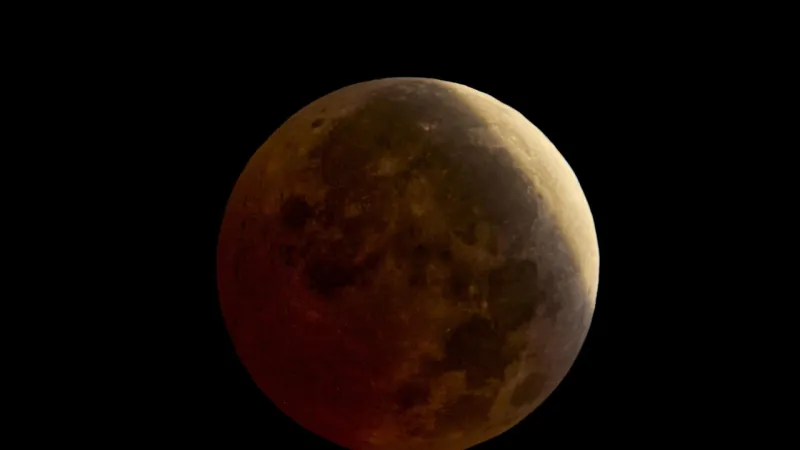
A rare and breathtaking partial lunar eclipse captivated skywatchers across the Western Hemisphere in the predawn hours today, as Earth's shadow consumed approximately 96% of the moon's surface, tinging it with a dramatic, fiery red hue. The celestial event offered an unparalleled spectacle, visible to millions who woke early to witness the astronomical phenomenon.
The near-total obscuration of the moon resulted from its precise alignment with the Sun and Earth, positioning our planet directly between the two celestial bodies. This specific configuration allowed Earth's atmosphere to filter sunlight, scattering blue light and permitting only red and orange wavelengths to reach the lunar surface, creating the distinctive blood moon effect.
The event commenced in the early morning, reaching its peak when the moon hung low in the western sky. Observers from North and South America, as well as parts of Europe and Africa, enjoyed prime viewing conditions, weather permitting, underscoring the broad reach of this cosmic ballet.
Astronomers explained that this particular lunar eclipse was classified as partial, despite covering such a significant portion of the moon, because a small sliver remained untouched by Earths umbra. Had the alignment been perfectly central, a total lunar eclipse would have occurred, immersing the entire moon in the deep reddish glow.
Social media platforms erupted with stunning images and excited commentary from amateur photographers and seasoned astronomers alike. The widespread fascination underscored humanitys enduring connection to the cosmic events unfolding above. Many communities organized special viewing parties, providing telescopes and expert guidance to enhance the experience.
While not as frequent as meteor showers, lunar eclipses remain a highlight for skywatching enthusiasts, often overshadowed only by total solar eclipses in terms of public interest. This recent event, with its near-total coverage and vivid coloration, certainly ranked among the most memorable in recent years, inspiring widespread awe.
Such a deeply colored partial lunar eclipse of this magnitude is not an everyday occurrence. Experts note that while lunar eclipses happen a few times each year, the visibility from specific regions and the extent of the shadow vary considerably. Stargazers eagerly anticipate the next significant celestial display, continuously monitoring astronomical calendars.
Modern technology played a crucial role for many, with live streams from observatories globally allowing those in less ideal locations or battling cloudy skies to experience the eclipse remotely. Dedicated applications provided real-time tracking and viewing tips, further enhancing the experience for countless individuals unable to witness it firsthand.
The event also served as a powerful educational moment, inspiring renewed interest in astronomy and space science among students and the general public. Schools and universities often leverage such occurrences to engage learners with practical demonstrations of orbital mechanics and light phenomena, bringing textbooks to life.
As the dawn broke fully, fading the crimson moon from view, the lingering awe served as a reminder of the universe's inherent capacity for spectacular beauty and the intricate cosmic dance that continually shapes our skies. The memory of the red moon will undoubtedly persist for those fortunate enough to witness its silent grandeur.