 Edward DP Situmorang
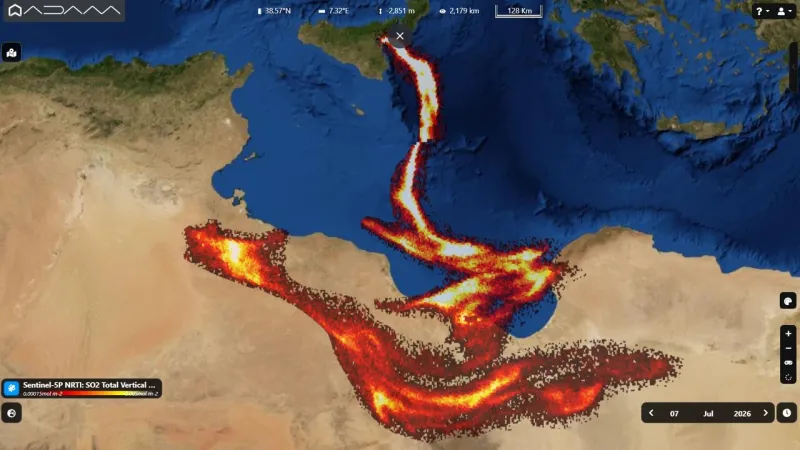
The Mount Etna volcano, one of the worlds most active, recently ejected a significant plume of sulfur dioxide that journeyed across the Mediterranean Sea, reaching as far as North Africa. This expansive atmospheric event was meticulously tracked and confirmed by the European Sentinel 5P satellite, underscoring the far-reaching impact of Sicily's dynamic geological landmark.
The phenomenon, captured by advanced satellite imagery, highlights the potent atmospheric effects of volcanic activity. Sulfur dioxide (SO2) is a colorless gas with a pungent odor, known for its potential to affect air quality and contribute to environmental issues like acid rain and haze formation. Its detection at such distances signifies substantial emissions from the stratovolcano.
Sentinel 5P, part of the European Unions Copernicus program, specializes in monitoring the Earths atmosphere. Its sophisticated instruments are designed to track key atmospheric constituents, including trace gases like SO2, nitrogen dioxide, ozone, and carbon monoxide, providing crucial data for climate research and air quality forecasting.
Experts routinely monitor Mount Etna due to its persistent activity, which includes effusive eruptions, explosive events, and gas emissions. While the current event did not necessarily involve a major eruptive phase, the volume and dispersal of the sulfur dioxide plume indicate vigorous degassing from the volcanic system.
The trajectory of the plume across the Mediterranean towards North Africa is primarily dictated by prevailing atmospheric currents and wind patterns. High-altitude winds can carry volcanic gases thousands of kilometers from their source, dispersing them over vast geographical areas.
Such long-distance transport of volcanic gases is not unprecedented. Major volcanic eruptions historically have demonstrated the capacity to inject aerosols and gases into the stratosphere, influencing global weather patterns and even temporarily altering temperatures. While Etna's emissions are typically not on that scale, their regular monitoring is essential.
The presence of sulfur dioxide in the atmosphere, even in diluted concentrations at a distance, warrants attention from environmental agencies. Prolonged exposure to elevated SO2 levels can pose respiratory health risks, particularly for vulnerable populations, and can also impact agricultural yields and sensitive ecosystems.
Scientists use the data from missions like Sentinel 5P to refine atmospheric models, better predict the movement of pollutants, and assess the broader environmental consequences of natural phenomena. The satellites continuous observations provide invaluable insights into our planets dynamic atmosphere.
This latest observation from Mount Etna serves as a stark reminder of the interconnectedness of Earths systems. A geological event in southern Europe can have atmospheric consequences stretching across an entire sea, affecting distant continents.
The continued vigilance of satellite programs ensures that such occurrences are not only observed but also thoroughly analyzed, contributing to a better understanding of both volcanic processes and global atmospheric chemistry. It underscores the critical role of space technology in environmental stewardship.