 Chris Robert
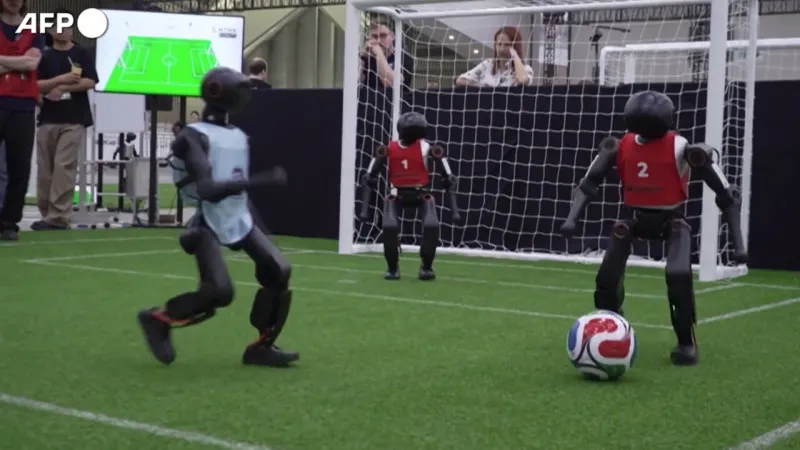
SEOUL, South Korea – Engineers from around the globe are converging in South Korea for the annual RoboCup tournament, a dynamic proving ground where advanced androids clash in spirited soccer matches. This international competition serves as a critical benchmark in artificial intelligence and robotics development, propelled by the ambitious long-term vision of creating a team of humanoid robots capable of defeating the human World Cup champions by the year 2050.
The RoboCup initiative, established in 1997, transcends mere entertainment. It functions as a grand challenge problem for AI and robotics research, pushing the boundaries of autonomous systems, real-time perception, intelligent decision-making, and robust motor control. Teams meticulously design, program, and refine their robotic athletes, simulating the complex demands of professional soccer.
The audacious goal of besting human champions by 2050 remains the driving force behind the tournament. This objective is not simply about winning a game; it encapsulates the mastery of fundamental AI challenges, including robust vision processing, dynamic balance, multi-robot coordination, strategic planning, and adaptive learning in unstructured environments.
Hosting the event, South Korea underscores its significant investment and prowess in robotics and artificial intelligence. The nation has emerged as a global leader in technological innovation, fostering an ecosystem ripe for cutting-edge research and development that aligns seamlessly with RoboCup's objectives.
The technical hurdles facing engineers are immense. Current robot designs, while impressive, still grapple with fluid motion, precise ball control, and instantaneous reaction times comparable to human players. Navigating a complex pitch, identifying teammates and opponents, and executing intricate passes require sophisticated algorithms and powerful hardware.
Over nearly three decades, RoboCup has witnessed remarkable advancements. Early robotic soccer players moved slowly and often fell; today's counterparts exhibit greater agility, improved locomotion, and rudimentary teamwork. Each year brings incremental, yet vital, progress toward the 2050 target.
The lessons learned within the RoboCup arena extend far beyond the soccer pitch. Innovations in robot vision, navigation, and human-robot interaction find direct application in areas such as autonomous vehicles, disaster response robots, industrial automation, and even assistive technologies for the elderly.
Dr. Lena Park, a lead researcher at Korea Advanced Institute of Science and Technology and a veteran RoboCup participant, emphasized the collaborative spirit. “RoboCup is more than a competition; it is a global research collaboration,” she stated during a recent press briefing. “The challenges we face here propel breakthroughs that will ultimately shape our daily lives.”
Teams from universities and research institutions worldwide, including those from the United States, Germany, Japan, and China, participate across various leagues, from smaller wheeled robots to larger humanoids. This diverse participation ensures a wide array of approaches and solutions to shared problems.
As robotic capabilities advance, conversations around the ethical implications of highly autonomous systems intensify. While RoboCup primarily focuses on technical prowess, the broader societal context of increasingly intelligent machines remains a subject of ongoing dialogue among scientists and policymakers.
The path to 2050 is challenging, but engineers express cautious optimism. Achieving human-level soccer performance will necessitate breakthroughs in machine learning, sensor integration, and mechanical design that are currently in their nascent stages. The RoboCup provides a tangible, measurable goal for this long-term endeavor.