 Robert Andrison
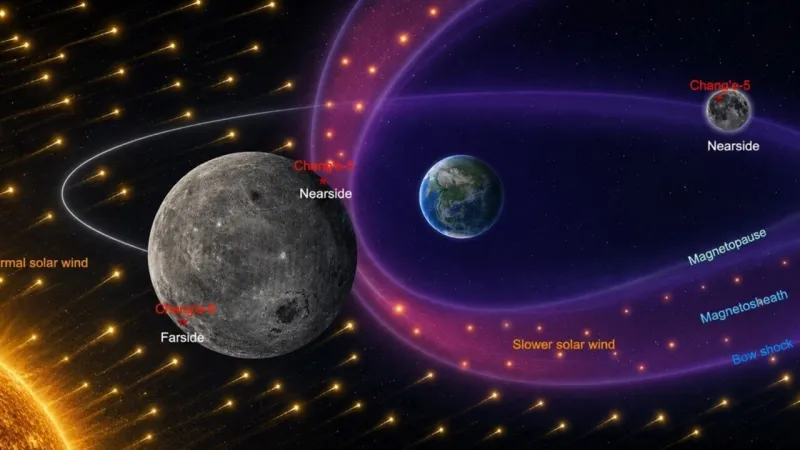
New scientific findings, drawn from regolith samples collected by China's Chang'e-6 mission from the Moon's far side, indicate that Earth's magnetic field plays a substantial and previously underestimated role in decelerating the solar wind as it reaches the Moon's visible hemisphere. This discovery offers a novel perspective on lunar space weathering and the protective influence of our planet across a vast cosmic distance.
Researchers analyzed the pristine lunar soil, or regolith, brought back by the historic Chang'e-6 mission, which successfully landed on and returned from the Moon's unexplored far side. These samples provided critical data points, allowing scientists to infer the conditions impacting the Moon's near side, particularly its interaction with the suns constant outflow of charged particles.
The solar wind, a stream of plasma consisting primarily of electrons and protons, continuously emanates from the Sun, bombarding celestial bodies throughout the solar system. Without a protective atmosphere or a strong intrinsic magnetic field, the Moon is typically considered highly vulnerable to this erosive force, leading to a phenomenon known as space weathering.
Earth possesses a powerful magnetosphere, a protective bubble generated by its molten iron core, which deflects the majority of the solar wind away from our planet. Scientists have long understood that when the Moon passes through Earths magnetotail—the elongated portion of the magnetosphere extending away from the Sun—it experiences a temporary reprieve from direct solar wind exposure.
The groundbreaking aspect of the recent analysis suggests a more pervasive influence. Even when the Moon is not directly within the magnetotail, Earths magnetic field appears to slow down the solar wind significantly before it reaches the lunar surface on the near side. This attenuated flow means the Moon receives a less energetic and less damaging bombardment than previously thought in these periods.
This deceleration has profound implications for understanding the chemical and geological evolution of the Moon. Space weathering alters the spectral properties of lunar regolith, impacting its reflectance and thus its appearance. A reduced solar wind impact could explain certain discrepancies in observed lunar surface characteristics.
The Chang'e-6 mission specifically targeted the far side, an area shielded from direct Earth observations, providing a unique dataset. The composition and structure of the regolith collected there, when compared with samples from the near side and theoretical models, allowed researchers to piece together this broader understanding of Earths distant shielding effect.
Previous models often assumed a relatively uniform exposure of the lunar surface to the solar wind, with minor temporary shielding events. These new findings necessitate a re-evaluation of those models, particularly concerning the long-term accumulation of solar wind implanted elements like hydrogen and helium on the Moon.
The discovery also holds relevance for future lunar exploration and potential resource utilization. Understanding the exact nature and variability of solar wind implantation is crucial for prospecting for volatile resources, such as water ice and helium-3, which are valuable for propulsion and energy generation.
The detailed analysis by the international scientific community, leveraging the rare samples provided by China's successful mission, underscores the intricate interplay between celestial bodies in our solar system. It highlights Earths ongoing, albeit passive, role in shaping the environment of its closest cosmic neighbor.
This research paves the way for further investigations using advanced lunar missions and laboratory analysis techniques. Scientists anticipate that subsequent studies will provide even more granular detail on how Earths magnetosphere modulates the space environment around the Moon, refining our understanding of lunar history and its potential for human habitation.