 Debby Wijaya
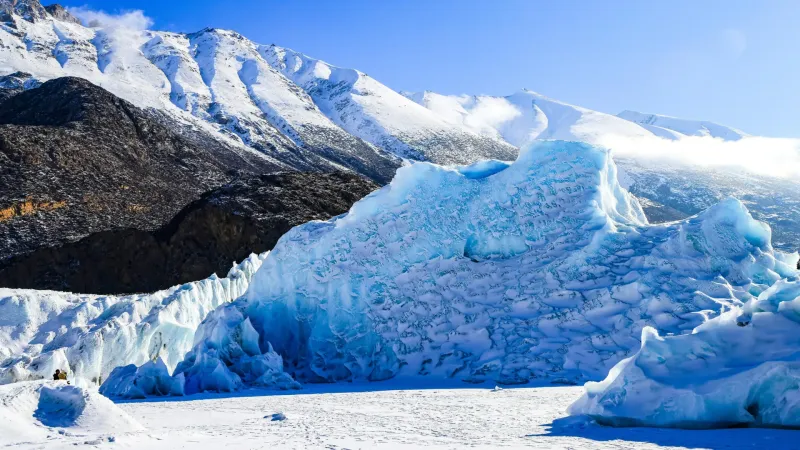
A groundbreaking scientific discovery high in Tibet has unearthed an ancient ice core estimated to be more than 128,000 years old, offering an unprecedented look into Earths past climate cycles. This pristine ice preserves a climatic record previously believed irretrievable, compelling researchers to reevaluate current understandings of glacial resilience and the broader mechanisms of global climate shifts.
This exceptionally aged ice, extracted from a remote Tibetan glacier, contains an extraordinary archive of atmospheric conditions from the last interglacial period. This era, preceding the most recent ice age, was characterized by warmer global temperatures, making the survival of such ancient ice a significant scientific anomaly.
Scientists are particularly intrigued by the implications of this discovery for climate history. The data locked within the ice could fundamentally reshape how we model and predict future climate changes, especially concerning the stability of vast ice sheets and the dynamics of sea-level rise.
Ice cores serve as natural time capsules, trapping air bubbles and microscopic dust particles from different geological epochs. By analyzing these layers, researchers can reconstruct past temperatures, atmospheric composition, and precipitation patterns with remarkable accuracy. The Tibetan core provides a direct window into a period of extreme climate variability.
The 128,000-year timeframe is critical because it spans a crucial warm interval where Earths climate was, in some respects, analogous to what modern climate models project for the coming centuries. Understanding how glaciers and ice sheets responded then offers invaluable context for present-day warming.
This finding directly challenges the long-held assumption that ice of such antiquity could not persist in regions outside the polar caps. The unique geological and atmospheric conditions of the Tibetan Plateau evidently acted as a powerful natural refrigerator, safeguarding this invaluable record against warmer periods.
The implications extend beyond mere historical reconstruction. Scientists can now refine their projections for how various regions might react to future warming, particularly regarding glacial melt rates. The Tibet ice core offers empirical data from a past warm climate, providing a vital benchmark.
Researchers involved in the project emphasize that this ancient ice record provides a rare opportunity to calibrate and validate existing climate models. Current models often rely on proxies and indirect evidence for such deep-time projections; this core offers direct, empirical data.
The effort to retrieve the core involved immense logistical challenges, given the extreme altitude and harsh environment of the Tibetan Plateau. Specialized drilling equipment and techniques were employed to extract the several hundred meters of ice without compromising its delicate historical integrity.
This discovery resonates with other scientific endeavors that push the boundaries of established understanding. Much like new calculations challenging fundamental physics principles, such as those that New Calculations Challenge Dark Energy, Reviving Einsteins Original Theory, this ancient ice core forces a reevaluation of our planetary climate narrative.
The analysis of the trapped air bubbles within the ancient ice will yield precise measurements of greenhouse gas concentrations during that distant past. This will provide crucial insights into natural carbon cycle dynamics before significant anthropogenic influence.
Furthermore, the integrity of this ice suggests that some high-altitude glaciers might harbor far older climate records than previously thought, opening new avenues for glaciological and paleoclimatological research globally.
The research team aims to publish a comprehensive analysis of the core data in leading scientific journals, anticipating a profound impact on the fields of atmospheric science, geology, and environmental studies. The ancient ice in Tibet is expected to become a cornerstone for future discussions on long-term climate resilience.
This unprecedented climate archive underscores the dynamic and complex nature of Earths climate system. It serves as a powerful reminder that while past warm periods occurred naturally, the speed and scale of current warming are distinct, making these historical insights ever more critical.
The findings are expected to fuel intensified research into similar high-altitude, low-latitude glacial environments worldwide, hoping to uncover other pockets of ancient ice that could further illuminate Earths enigmatic climatic past. Each such discovery brings humanity closer to a more complete picture of its environmental heritage.
Ultimately, the revelation of this 128,000-year-old Tibet ice core offers more than just a historical curiosity; it provides a vital scientific instrument to better grasp the planet's vulnerabilities and build more robust strategies for adaptation in a rapidly changing world. Its secrets, once lost, are now beginning to unfold.