 Edward DP Situmorang
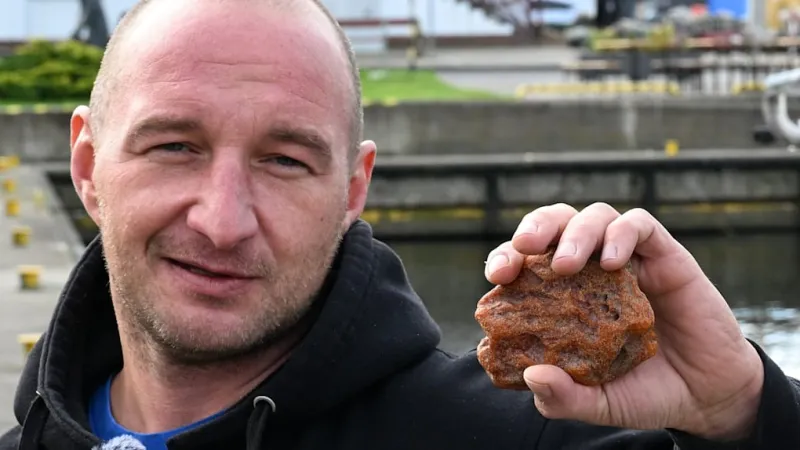
Gdansk, Poland – A seasoned Polish fisherman, Patryk Rewinski, recently experienced what many in his profession describe as a once-in-a-lifetime event, hauling in a remarkably rare, fist-sized piece of Baltic Sea amber. The significant discovery occurred during a routine fishing expedition, marking a profound moment in his 20-year career navigating the challenging waters of the Baltic.
Rewinski, who has spent two decades plying the rich fishing grounds of the region, found the exceptionally large piece of fossilized tree resin entangled within his nets. This find is considered an absolute rarity by experts, with preliminary estimates regarding its considerable value already circulating.
The Baltic Sea is renowned globally as the primary source of the highest quality amber, often referred to as "Baltic gold." However, pieces of this magnitude, large enough to fill a human fist, are exceedingly uncommon, making Rewinski's discovery particularly noteworthy.
For centuries, amber has captivated humanity, prized for its aesthetic beauty, its use in jewelry, and its scientific importance. As ancient tree resin, it often contains perfectly preserved insects, plants, or other organic matter, offering invaluable insights into prehistoric ecosystems.
While the specific age of Rewinski's amber piece is yet to be determined, such substantial finds typically originate from deposits that are tens of millions of years old. The intricate process of fossilization transforms the sticky resin into the hard, translucent gem we recognize today, a process requiring specific geological conditions over vast stretches of time.
Experts are keen to examine the amber for any inclusions that might further elevate its scientific or monetary value. Even without such entombed artifacts, the sheer size and pristine condition of Rewinski's discovery place it in a category of its own.
The market for amber, particularly for large, high-quality specimens, remains robust, driven by collectors, jewelers, and scientific institutions alike. Its deep cultural significance, particularly in the Baltic region, also contributes to its enduring appeal.
Rewinski himself reportedly expressed astonishment at the find, reflecting on the countless hours he has spent at sea. “It happens once in a lifetime,” he is quoted as saying, encapsulating the sheer improbability and significance of his catch.
This discovery underscores the continued potential of the Baltic Sea to yield treasures from its depths, reminding us that even in well-traversed waters, nature still holds extraordinary secrets. The initial excitement surrounding Rewinski's amber will likely lead to a more formal appraisal and potentially an auction, where its true market value will be established.
Beyond its monetary implications, the find offers a tangible link to ancient Earth, a window into epochs long past. Such discoveries contribute to our broader understanding of geological history and the evolution of life. Researchers continue to find new ways to unlock the secrets held within these ancient resins, much like recent scientific endeavors to understand prehistoric life through genetic material, as seen in studies like Ancient Viral DNA Unlocks Secrets of Human Brain Evolution.
The fisherman's remarkable haul serves as a poignant reminder of the enduring allure and scientific value of natural wonders. It also highlights the unexpected fortunes that can emerge from dedicated work in traditional industries.