 Chandra Wijayanto
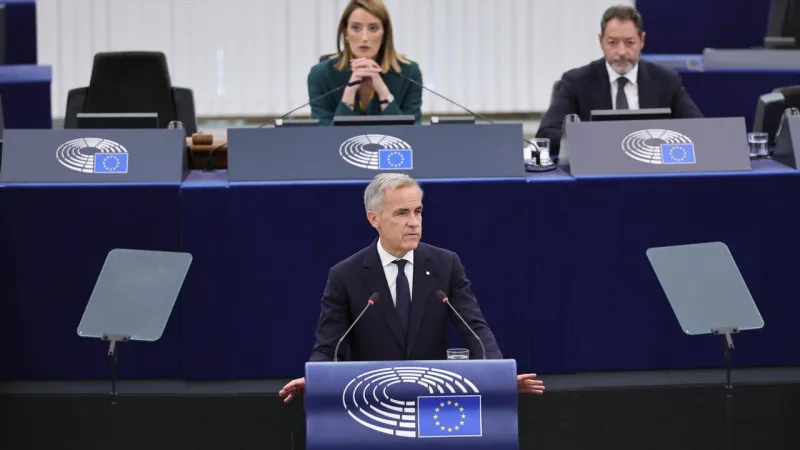
Strasbourg, Europe — Canadian Prime Minister Carney declared before the European Parliament today that a more robust Canada inherently serves the interests of the United States, a pronouncement delivered amidst evolving transatlantic relations under President Donald Trump. Speaking at the plenary session, Carney underscored deep affinities between Canada and Europe, advocating for reinforced collaboration across the Atlantic.
The prime minister's address highlighted Canada's strategic position as a bridge between North America and Europe, emphasizing shared democratic values and economic interconnectedness. His remarks came at a time when global alliances face increasing scrutiny and geopolitical shifts.
Carney articulated a vision where Canada's strength, derived from its stable economy, commitment to multilateralism, and diverse society, directly contributes to broader North American security and prosperity. He posited that a flourishing Canada provides a more reliable and effective partner for its southern neighbor.
The explicit mention of the United States and its benefit from a strong Canada directly addresses concerns often voiced within President Donald Trump's administration regarding burden-sharing and alliance effectiveness. It subtly reframed Canada's international engagement not as a divergence, but as a complementary effort.
Carney devoted a significant portion of his speech to the profound similarities between Canada and Europe. He cited a shared dedication to human rights, environmental protection, and democratic principles as cornerstones of their enduring partnership. These commonalities, he argued, form the bedrock for deeper cooperation.
This call for unity resonates with previous statements, as Carney has consistently advocated for stronger transatlantic bonds. Indeed, in recent months, he has stressed that Canada and Europe Stand Stronger Together, Urges Unity in the face of global challenges.
The context of his address is critical. International trade agreements and diplomatic relations have been subject to renegotiation and increased pressure globally. Canada's proactive stance seeks to stabilize these relationships.
Analysts suggest Carney's statement in Europe was a nuanced diplomatic message intended for Washington, aiming to project Canada's value as an ally and counter any perceptions of weakening ties with its largest trading partner.
This diplomatic tightrope walk is particularly relevant given recent tensions. President Donald Trump has previously threatened EU tariffs over Canada's alliance, signaling potential trade ruptures if alliances are perceived as undermining US interests. Carney's speech appeared designed to mitigate such sentiments.
Economically, Canada and the European Union enjoy substantial trade ties, which Carney underscored as vital for both economies. He advocated for continued efforts to streamline trade and investment, creating mutual benefits that ripple across the global marketplace.
The prime minister championed multilateralism as the most effective approach to tackle complex global issues, from climate change to security threats. He positioned Canada and Europe as natural partners in upholding and strengthening international institutions.
Carney consistently conveyed the message that the inherent strength of Canada, rooted in its pluralism and unwavering commitment to global cooperation, provides a stabilizing force for the entire North American continent, directly benefiting American prosperity and security. This statement encapsulates his core argument.
Looking ahead, the speech laid the groundwork for further diplomatic engagements, signaling Canada's intent to remain a significant voice on the world stage, actively shaping international dialogue rather than merely reacting to it.
The reception within the European Parliament was largely positive, with many MEPs echoing the sentiment of shared values and the importance of a strong transatlantic partnership. The applause underscored a consensus on the need for like-minded nations to collaborate.
Carney's leadership in articulating Canada's role as a reliable and constructive global actor provides an important counter-narrative to isolationist tendencies that have emerged in various parts of the world.