 Debby Wijaya
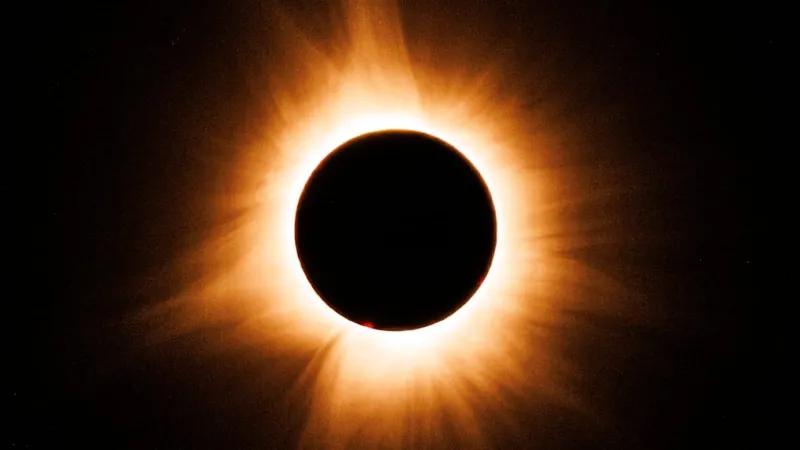
On August 12, Germany will experience a rare total solar eclipse, an astronomical phenomenon where the Moon completely obscures the Sun, plunging parts of the nation into a dramatic, temporary twilight. The highly anticipated celestial event is expected to reach its maximum visibility at specific locations, captivating sky-watchers across the country.
A total solar eclipse occurs when the Moon passes directly between the Sun and Earth, casting a shadow that momentarily darkens the sky. This precise alignment transforms daytime into an eerie dusk, revealing the Sun's ethereal corona, which is otherwise hidden by the star's overwhelming brightness.
While a partial eclipse will be visible across much of Central Europe, only a narrow band traversing Germany will witness the breathtaking totality. Experts predict the darkest moments will occur over specific regions, with detailed maps and timetables provided by scientific institutions to guide observers to optimal viewing spots.
The occurrence of a total solar eclipse over a specific geographic area is a relatively rare event, making the August 12 spectacle particularly significant for German residents and visiting astronomy enthusiasts. Such events offer unique opportunities for scientific research and public engagement with celestial mechanics.
Astronomically, the Moon appears to perfectly cover the Sun because, despite being approximately 400 times smaller, it is also roughly 400 times closer to Earth than the Sun. This cosmic coincidence allows for the stunning visual effect of totality, a momentary balance between two celestial giants.
Observing a total solar eclipse requires stringent safety precautions. Staring directly at the Sun, even when partially obscured, can cause permanent eye damage. Certified eclipse glasses or pinhole projectors are essential for safe viewing during the partial phases. Only during the brief period of totality, when the Sun is entirely hidden by the Moon, is it safe to view the corona with the naked eye.
Preparations for the eclipse are already underway, with national media outlets and astronomical societies disseminating information on safe viewing practices and optimal observation points. Public events, including organized viewing parties and educational seminars, are being planned to maximize public enjoyment and understanding of the phenomenon.
Throughout history, total solar eclipses have been regarded with both awe and trepidation, often influencing cultural narratives and scientific advancements. Ancient civilizations interpreted them as omens, while modern science uses them to study the Sun's outer atmosphere and validate theories of relativity.
For researchers, the fleeting moments of totality provide invaluable opportunities to study the Sun's corona, its outermost layer, which is crucial for understanding solar activity and space weather. Instruments are often deployed to capture data on temperature, composition, and magnetic fields during these brief windows.
This total solar eclipse in Germany serves as a powerful reminder of the dynamic nature of our solar system and the predictable yet awe-inspiring movements of celestial bodies. While this event is eagerly anticipated, the next total solar eclipse visible from Germany will not occur for many decades, making the August 12, 2026, event a truly generational experience.