 Demian Sahputra
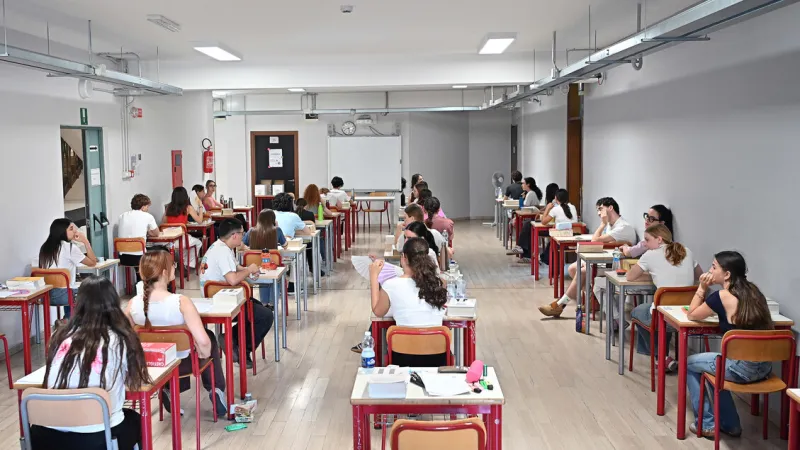
Rome, Italy – Thousands of Italian high school students across the nation recently concluded the demanding second phase of their Maturità state examinations, confronting a diverse array of subjects ranging from classical Latin prose to intricate mathematics problems and contemporary issues like artificial intelligence. The rigorous assessments, pivotal for secondary school graduation, tested candidates on their analytical skills and broad knowledge base, marking a significant milestone in their academic journeys.
The humanities track students grappled with a passage from Quintilian's Institutio Oratoria for their Latin paper. This choice underscored the Italian education system's enduring commitment to classical studies, requiring students to translate and critically analyze the Roman rhetorician's complex arguments on education and eloquence. Such an examination demands not only linguistic proficiency but also a deep understanding of ancient philosophy and pedagogical thought.
Concurrently, scientific track students faced a challenging mathematics exam, which notably included a problem centered on Lake Bracciano. This specific question reportedly involved complex geometrical and analytical reasoning, drawing significant attention and even expert commentary. An Italian Math Exam's Lake Problem Deemed Unrealistic by Expert, highlighting the perceived difficulty and perhaps a disconnect from practical applications for some.
Beyond the core subjects, the examination also ventured into modern scientific and societal debates. Reports indicated the presence of questions related to the Olympics, requiring students to consider themes of sportsmanship, international relations, or the historical impact of the games. More significantly, the inclusion of artificial intelligence, or IA as it is termed in Italy, signaled an acknowledgement of emerging technologies within the traditionally structured curriculum.
Further diversifying the scope were topics addressing genetically modified organisms (GMOs) and the specific regional context of Friuli. Questions on GMOs likely probed ethical considerations, scientific advancements, and their impact on agriculture and society. The reference to Friuli could have involved historical, geographical, or socio-economic aspects pertinent to the region, reflecting a desire to test students on both global and local issues.
The Maturità exams are more than just academic hurdles; they are a deeply ingrained cultural rite of passage in Italy, often eliciting high levels of anxiety and preparation from students, families, and educators alike. The results significantly influence students' eligibility for university admissions and often shape their future academic and professional trajectories.
For decades, the Maturità has served as the ultimate test of a student's preparedness for higher education and adult life. Its design consistently aims to assess not only rote memorization but also critical thinking, problem-solving capabilities, and the ability to synthesize information from various disciplines. The current format, while evolving, maintains a strong emphasis on comprehensive knowledge.
Educational experts often debate the balance between preserving classical traditions and integrating modern subjects into the Maturità. The recent inclusion of topics like AI and GMOs suggests a concerted effort by the Ministry of Education to update the curriculum, ensuring it remains relevant in a rapidly changing world while still valuing Italy's rich intellectual heritage. This blend aims to prepare students for both their national identity and global citizenship.
Student reactions to the diverse exam topics are predictably varied. While some found the classical texts stimulating and the mathematical challenges invigorating, others expressed apprehension regarding the complexity of emerging fields like artificial intelligence, which may not be uniformly covered in all high schools. The breadth of subjects tested demands a versatile and adaptable approach from candidates.
The outcomes of these exams will not only determine graduation status but also provide a snapshot of the national education system's effectiveness in equipping the next generation with essential skills. As Italy navigates a future shaped by technological innovation and global challenges, the Maturità continues to adapt, albeit gradually, to meet these evolving demands.
The emphasis on both ancient wisdom and cutting-edge science underscores a foundational philosophy within Italian pedagogy: that a holistic education prepares individuals not just for specific careers, but for a lifetime of learning and critical engagement with the world around them. This comprehensive approach is designed to cultivate well-rounded citizens capable of contributing meaningfully to society.