 Debby Wijaya
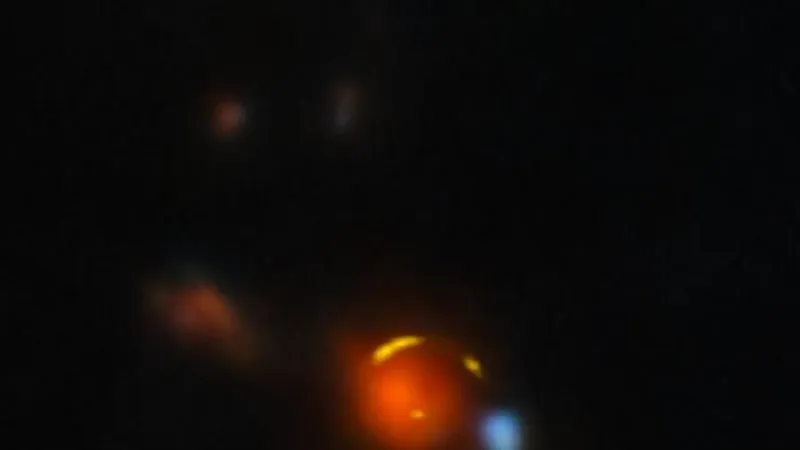
Scientists have announced a profound discovery that reshapes our understanding of cosmic phenomena: a galaxy located an astounding 11 billion light-years from Earth actively functions as an ultra-high-energy neutrino factory. This groundbreaking identification was made possible through the combined efforts of the IceCube Neutrino Observatory and a sophisticated network of telescopes across the globe, providing an unprecedented view into the universe's most extreme processes.
Neutrinos, often dubbed ghost particles, are fundamental subatomic particles that carry no electric charge and interact very weakly with matter. They travel at nearly the speed of light, traversing vast cosmic distances unimpeded, making them invaluable messengers from the universe's most violent events. Their detection offers a unique window into environments inaccessible by conventional electromagnetic radiation.
The designation neutrino factory signifies a celestial object that produces neutrinos at exceptionally high energies, far beyond those created in typical stellar processes. Such factories are often associated with phenomena like supermassive black holes accreting matter, powerful gamma-ray bursts, or rapidly expanding supernova remnants, all capable of accelerating particles to relativistic speeds.
The crucial evidence originated from the IceCube Neutrino Observatory, embedded deep within the ice at the South Pole in Antarctica. This colossal detector uses thousands of sensors to detect the faint blue light, known as Cherenkov radiation, produced when high-energy neutrinos collide with atomic nuclei within the ice. These interactions reveal the neutrinos trajectory and energy.
Complementing IceCube's data, a global network of electromagnetic telescopes observed the same region of the sky. This multi-messenger approach, combining observations from neutrinos and photons, allowed researchers to pinpoint the exact celestial source of these energetic particles. It represents a triumph of modern astrophysics, integrating diverse observational techniques.
The identified galaxy, a staggering 11 billion light-years away, presents a rare opportunity to study a cosmic engine from the early universe. Light, and by extension neutrinos, traveling from such distances carry information from a time when the universe was only a quarter of its current age, providing clues about its evolution and the formation of its most powerful structures.
This discovery holds profound implications for cosmology. It suggests that such high-energy particle acceleration mechanisms were robustly active even in the early universe. Understanding these ancient sources can help astrophysicists refine models of galaxy formation, the evolution of active galactic nuclei, and the history of cosmic ray production.
Neutrino astronomy faces unique challenges due to the elusive nature of these particles. Their minimal interaction with matter makes them difficult to detect, requiring massive detectors like IceCube. However, this same property ensures that neutrinos provide an undistorted view of their sources, unlike light which can be absorbed or scattered.
Scientists anticipate that continued observations of this distant neutrino factory and others yet to be discovered will yield further insights. The field of high-energy neutrino astrophysics is rapidly advancing, promising to unravel mysteries surrounding the origins of cosmic rays and the most powerful accelerators in the cosmos.
The success of this endeavor underscores the critical role of international collaboration in large-scale scientific research. The coordination between ground-based telescopes, space-based observatories, and neutrino detectors exemplifies how diverse scientific communities converge to push the boundaries of human knowledge about the universe.
By detecting neutrinos from such an immense distance, scientists are essentially peering back in time. The 11 billion light-year journey of these particles means that we are observing the galaxy as it existed billions of years ago, offering a direct glimpse into the high-energy processes that shaped the early cosmos.
This finding not only advances astrophysics but also impacts particle physics, as the observed energies push the limits of known physics. Studying these extreme neutrinos could potentially reveal new particles or interactions, thus deepening our fundamental understanding of matter and forces.