 Edward DP Situmorang
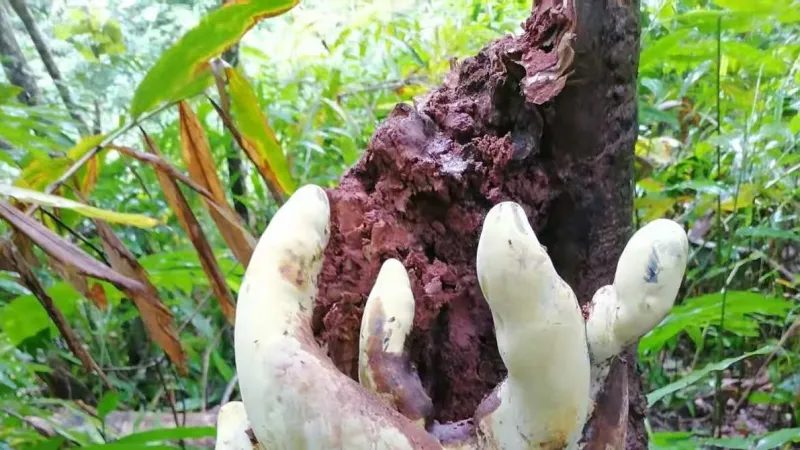
A monumental discovery has been unveiled by scientists in China, revealing a new species of giant fungus, Dianjunus rex, capable of towering up to 20 inches. This colossal organism emerged swiftly after the cataclysmic mass extinction event that eradicated the dinosaurs, offering a rare glimpse into Earths ancient ecosystems.
The newly identified species, formally designated Dianjunus rex, derives its name from the Latin word rex, meaning king, a fitting moniker for its impressive stature. Its scientific classification places it within the broader fungal kingdom, yet its sheer size distinguishes it significantly from most known contemporary or fossilized fungi.
Researchers from a prominent Chinese scientific institution, whose full findings are pending publication in a peer-reviewed journal, confirmed the funguss remarkable dimensions. Specimens discovered during expeditions measured up to half a meter in height, presenting an astonishing visual unlike typical mushroom forms.
The most striking aspect of this discovery lies in its temporal context. Dianjunus rex appeared on the planet shortly after the Cretaceous-Paleogene (K-Pg) extinction event, approximately 66 million years ago. This period marked a profound environmental upheaval, necessitating rapid evolutionary adaptations among surviving life forms.
During this tumultuous era, terrestrial ecosystems were undergoing radical restructuring. The sudden absence of large herbivorous dinosaurs would have dramatically altered nutrient cycles and vegetation distribution, creating novel niches for opportunistic organisms like this giant fungus.
Scientists hypothesize that Dianjunus rex likely played a crucial role in decomposing vast quantities of organic matter in the post-extinction landscape. Its ability to grow to such prodigious sizes might have enabled it to access deep woody substrates or decaying megaflora, accelerating the recycling of essential nutrients.
The fossil record of fungi is notoriously sparse due to their delicate composition, making the preservation and subsequent discovery of Dianjunus rex an exceptional event. Such finds provide invaluable data points for paleontologists and mycologists reconstructing ancient biological communities.
Understanding the adaptations of organisms like this giant fungus during periods of extreme environmental stress offers critical insights into ecological resilience. It helps scientists comprehend how life re-establishes itself following catastrophic events and the mechanisms driving biodiversity recovery.
The discovery site, though precise coordinates remain undisclosed pending further research and conservation efforts, is understood to be in a region of China known for its rich paleontological potential. This area has yielded other significant finds that shed light on prehistoric life.
Future research will undoubtedly focus on analyzing the genetic makeup of Dianjunus rex specimens, if viable organic material can be extracted. Such analysis could reveal its phylogenetic relationships to modern fungi and further illuminate its unique evolutionary trajectory.
This discovery underscores the vast, unexplored biodiversity that still exists, both in present-day ecosystems and within Earths ancient history. It serves as a powerful reminder of the continuous revelations awaiting scientific exploration.
Mycologists have long speculated about the presence of larger fungal forms in prehistoric times, given the generally richer oxygen levels and different ecological pressures. Dianjunus rex provides concrete evidence supporting these theories, adding another layer to our understanding of ancient megaflora.
The implications extend beyond mere biological classification. This giant fungus offers a unique bio-indicator, reflecting the environmental conditions and nutrient availability in the immediate aftermath of one of Earths most significant extinction events.
Conservation efforts around the discovery site will be paramount to protect further specimens and ensure responsible study of this rare find. International collaboration is anticipated to fully unlock the secrets held within Dianjunus rex.