 Angela Stefani
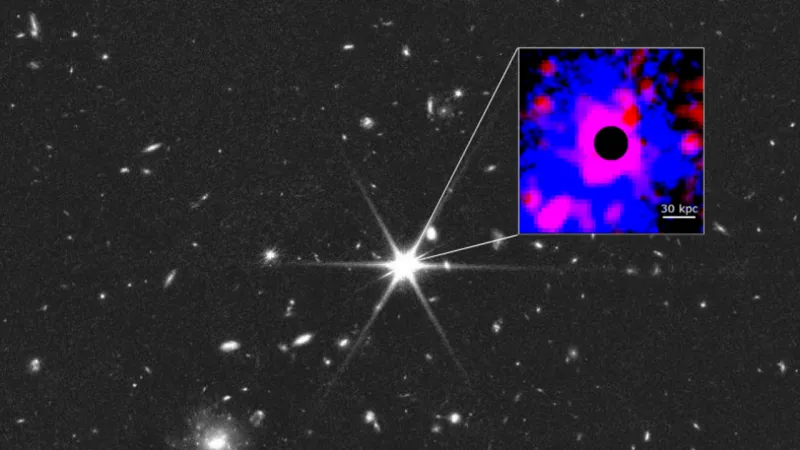
Astronomers utilizing NASA's Chandra X-ray Observatory have achieved a groundbreaking milestone, detecting the very first signs of hot, diffuse gas within a nascent galaxy cluster that formed a mere 2 billion years after the Big Bang. This unprecedented observation, requiring 180 hours of meticulous data collection, offers pivotal insights into the earliest epochs of cosmic evolution and the mechanisms driving the assembly of the universe's largest structures.
The detection of this early warmth provides direct evidence of a fundamental process: the heating of intergalactic gas as structures coalesce under gravity. Previously, such mature, hot gas clusters were believed to form much later in cosmic history. This discovery pushes back the timeline for when these massive cosmic furnaces began to take shape.
When the universe was just two billion years old, it was a profoundly different place compared to its current 13.8 billion-year age. Galaxies were actively forming, merging, and evolving rapidly. Observing a galaxy cluster in this early, energetic state is akin to witnessing the universe's infancy, offering a unique window into its formative years.
The Chandra X-ray Observatory, renowned for its ability to detect X-ray emissions from extremely hot cosmic phenomena, proved indispensable for this investigation. Its prolonged observation period allowed scientists to gather enough faint X-ray signals emanating from the primordial hot gas, confirming its existence and properties. The X-rays are generated when gas is compressed and heated to millions of degrees Celsius during the gravitational collapse of matter.
Galaxy clusters are the most massive known structures in the universe, typically containing hundreds or even thousands of galaxies bound together by gravity, permeated by vast amounts of superheated gas that emits X-rays. Understanding their origins is crucial for comprehending the large-scale structure of the cosmos and the distribution of matter within it.
This finding challenges some prevailing models of cosmic structure formation, suggesting that the processes leading to the accumulation and heating of intergalactic gas were more efficient or occurred earlier than previously theorized. It implies a rapid initial assembly phase for these colossal cosmic entities.
The heating of the gas within these developing clusters is a complex phenomenon. It involves not only the gravitational pull of dark matter and baryonic matter but also feedback mechanisms from active galactic nuclei and supernovae within the constituent galaxies. These energetic events inject immense amounts of energy into the surrounding gas, elevating its temperature.
Scientists will now use this data to refine their simulations and theoretical models of the early universe. The detailed X-ray spectrum obtained by Chandra can reveal the temperature, density, and chemical composition of the hot gas, providing a comprehensive profile of this ancient cosmic environment.
Future observations with next-generation telescopes, both in X-ray and other wavelengths, will aim to identify more such nascent galaxy clusters to build a more complete picture of their early development. Such comparative studies will be vital for confirming these initial findings and exploring the diversity of cluster formation pathways.
The study underscores the continued importance of advanced astronomical observatories like Chandra in pushing the boundaries of our cosmic understanding. By peering back to a time when the universe was in its tumultuous youth, astronomers gain critical perspectives on the fundamental forces that sculpted the galaxies and structures we observe today.
This discovery represents a significant leap forward in cosmology, illuminating the formative years of the universe's most colossal structures. It provides tangible evidence of how the seeds of present-day cosmic giants were sown and began to flourish just a few billion years after the Big Bang.
The extensive observation time dedicated to this project highlights the patience and precision required in modern astrophysics. Gathering these faint signals from such immense cosmic distances demands not only sophisticated instrumentation but also dedicated scientific effort and perseverance. The X-ray emission, traveling billions of years to reach Earth, carries direct information about the conditions in the early universe.
The implications of this early hot gas detection extend to understanding the interplay between dark matter and ordinary matter. Dark matter provides the gravitational scaffolding upon which galaxy clusters form, and the behavior of the hot gas within these structures serves as a tracer for this elusive component of the universe.
Researchers anticipate that further analysis of this data, coupled with multi-wavelength observations from other telescopes, will unlock even more secrets of this ancient galaxy cluster. The combination of X-ray data with optical and radio observations can paint a holistic picture of these early cosmic behemoths.
Ultimately, this breakthrough brings humanity closer to answering profound questions about our cosmic origins, how the universe evolved from a relatively uniform plasma into the rich tapestry of stars, galaxies, and clusters we observe today. It reinforces the dynamic and ever-unfolding nature of the cosmos, even billions of years in the past.