 Stefani Rindus
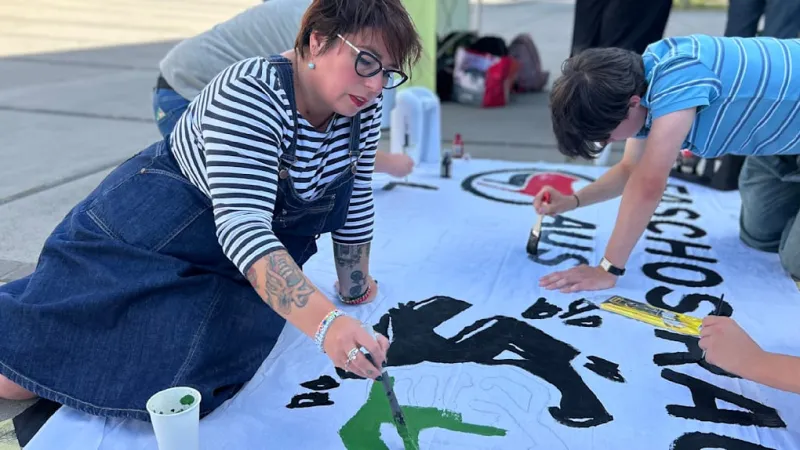
DESSAU – The Green Party youth organization, Grüne Jugend, alongside its lead candidate for the upcoming Saxony-Anhalt election, publicly launched their campaign with a potent display of anti-fascist art outside the Bauhaus Museum. The event saw participants meticulously paint a banner directly targeting "fascists," explicitly framing the Alternative for Germany (AfD) as a primary opponent in the contentious political landscape.
The campaign kickoff served as a visible statement of intent, signaling the Greens' determination to confront what they perceive as rising far-right sentiment in the region. The banner, a central feature of the event, incorporated symbols challenging extremist ideologies, drawing a clear line in the sand ahead of the pivotal state election.
This bold artistic protest comes as political tensions escalate in Saxony-Anhalt, a state where the AfD commands significant electoral support. The Green Party's leadership aims to energize its base and attract undecided voters through a clear, uncompromising message against right-wing extremism.
However, the campaign messaging also included a notable caveat, acknowledging the complexity of the political landscape. The banner itself reportedly stated that designating voters as inherently right-wing would be "completely absurd." This nuance suggests an attempt to differentiate between the party's policies and its individual supporters, perhaps to avoid alienating potential voters or provoking a backlash.
The Saxony-Anhalt election campaign is poised to be fiercely contested, with various parties employing distinct strategies to secure votes. An initiative urging tactical voting to prevent an AfD majority underscores the high stakes involved. For more context, see Sachsen-Anhalt Initiative Urges Tactical Voting to Halt AfD Majority.
The state has witnessed a notable rise in support for the AfD in recent years, reflecting broader trends across eastern Germany. This makes the Green Party's direct confrontation all the more significant, as it seeks to reverse this trajectory and champion progressive values.
Green Party strategists likely view such high-profile, visually impactful events as crucial for cutting through the noise of traditional campaigning. By focusing on a clear ideological battle, they aim to galvanize younger voters and those concerned about democratic values.
The scrutinization of political parties and their candidates is a recurring theme in German electoral politics. States like Lower Saxony have implemented measures to test the constitutional fidelity of AfD candidates before elections, highlighting national concerns about the party's stance. Such efforts are indicative of the broader challenges democratic institutions face when confronted with parties perceived to be at the fringes. Read more about this at Lower Saxony Tests AfD Candidates' Constitutional Fidelity Before Elections.
The use of art as a form of political protest is a longstanding tradition, often employed to convey powerful messages and mobilize public opinion. The Bauhaus Museum, a symbol of modernist art and progressive ideals, provided a fitting backdrop for the Grüne Jugend's demonstration.
As the Saxony-Anhalt election draws nearer, the campaign tactics employed by all parties will be under intense scrutiny. The Green Party's initial move suggests a willingness to engage in direct ideological conflict, setting a combative tone for the weeks ahead in this critical regional contest.