 Stefani Rindus
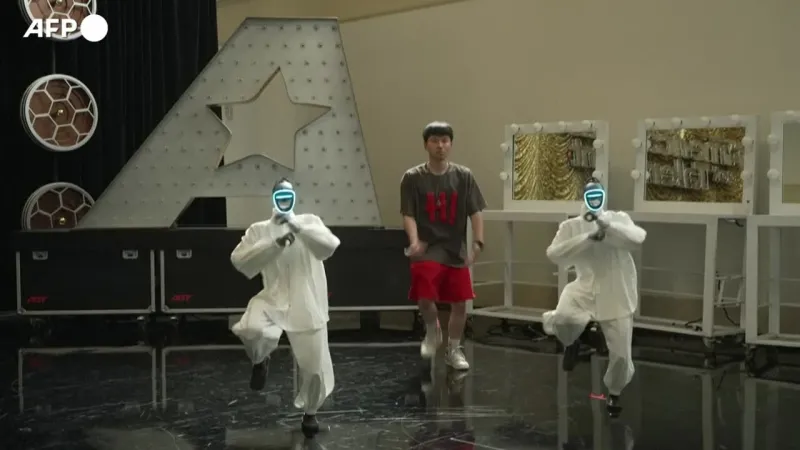
LOS ANGELES – The grand finale of America's Got Talent recently witnessed a spectacular and unprecedented collaboration as a dancer took to the stage alongside a troupe of advanced humanoid robots, developed by the Chinese technology firm Unitree. The performance, which seamlessly blended human artistry with cutting-edge artificial intelligence, featured intricately synchronized choreographies and precise kung fu maneuvers, captivating the live audience and millions watching nationwide. This innovative act marked a significant moment for the intersection of robotics and entertainment, pushing the boundaries of what is possible on a global stage.
The visual spectacle was nothing short of astonishing. The robots, appearing both agile and robust, moved in perfect unison with their human counterpart, executing complex sequences that demanded both precision and fluidity. From graceful balletic pirouettes to sharp, powerful martial arts stances, the performance highlighted the sophisticated programming and mechanical dexterity embedded within each Unitree unit.
Unitree, a company recognized globally for its pioneering work in legged robots, provided the technological backbone for this groundbreaking act. Their research and development efforts have consistently focused on creating robots capable of dynamic movement and real-world application, often showcased through viral videos of their creations navigating challenging terrains or performing complex tasks.
The robots employed in the America's Got Talent finale represent the pinnacle of current humanoid robotics. Equipped with advanced sensors, powerful servomotors, and sophisticated control algorithms, they are designed to mimic human motion with remarkable accuracy. This level of autonomy and coordination requires complex programming, allowing the robots to interpret and execute intricate dance routines without discernible delay.
This performance transcends mere entertainment; it underscores a burgeoning era where technology and performing arts merge to create novel experiences. For years, the entertainment industry has explored integrating digital effects and animatronics, but the live, interactive presence of highly mobile humanoid robots introduces a new dimension to stagecraft and performance art.
Judges and audience members alike expressed awe at the seamless interaction between the dancer and the robotic ensemble. Social media platforms immediately erupted with discussions about the performance, with many marveling at the technical prowess and the sheer artistic vision. It sparked conversations about the future potential of such collaborations in various forms of live entertainment.
The success of the Unitree robots on America's Got Talent has far-reaching implications beyond the realm of reality television. It signals a growing capability for artificial intelligence and robotics to engage with human creativity in meaningful ways. Experts suggest that such demonstrations could accelerate public acceptance and understanding of advanced robotics in everyday life.
The collaboration emphasized a harmonious human-robot synergy, rather than a competition. The dancer acted not just as a choreographer, but as an integral part of an expanded ensemble, highlighting how human ingenuity can direct and elevate robotic capabilities to achieve artistic expression previously unimaginable.
Beyond entertainment, the technologies showcased by Unitree have potential applications in fields requiring precision movement and complex interaction, such as manufacturing, exploration, and even assistance in challenging environments. The ability to perform synchronized, delicate maneuvers suggests a versatile platform for future development.
The act's journey through the rigorous competition stages of America's Got Talent built anticipation for its finale presentation. Each successive performance refined the integration between human and machine, culminating in a polished act that left an indelible mark on the show's history and captivated the global audience.
This performance serves as a powerful testament to human innovation and the rapid advancements in robotics over the past decade. It challenges preconceived notions about technology, presenting robots not merely as tools, but as potential partners in creative endeavors.
The increasing sophistication of robotics, often driven by advancements in artificial intelligence, continues to be a topic of global discussion among scientists and policymakers. This act brought these complex technological discussions into mainstream popular culture, making advanced concepts accessible and visually compelling.
Ultimately, the appearance of Unitree's humanoid robots on such a high-profile platform has undeniably cemented their place in the collective consciousness, not just as feats of engineering but as contributors to a new chapter in performing arts.
The finale performance on America's Got Talent will be remembered as a pivotal moment, showcasing how human creativity, when augmented by sophisticated robotics, can push the boundaries of artistic expression and redefine what is considered possible in live entertainment.