Gabriella
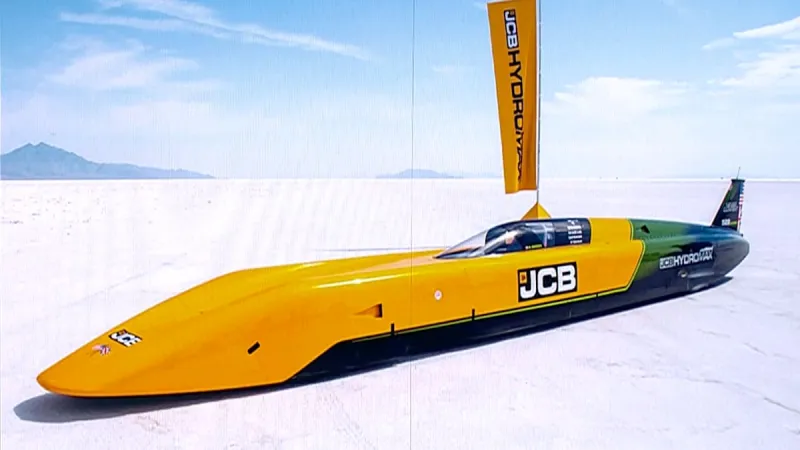
UTAH -- The barren expanse of Utah's iconic salt flats recently bore witness to a historic engineering triumph as the hydrogen-powered JCB Hydromax shattered conventional speed barriers, reaching an astonishing velocity of nearly 675 kilometers per hour. Piloted by the acclaimed British Royal Air Force veteran, Commander Andy Green, this groundbreaking feat not only secured a new land speed record for hydrogen-fueled vehicles but also underscored the burgeoning potential of sustainable propulsion technology.
The achievement marks a significant milestone in the quest for zero-emission high-performance vehicles, positioning hydrogen as a viable and potent alternative to traditional fossil fuels. The JCB Hydromax, engineered with meticulous precision, harnessed an formidable 1600 horsepower to propel itself across the vast, flat terrain, pushing the boundaries of what was previously considered possible for green technology on the ground.
Commander Green, renowned for his previous land speed records with the ThrustSSC, once again demonstrated unparalleled skill and courage at the helm of a cutting-edge machine. His expertise was instrumental in navigating the challenging conditions of the salt flats, ensuring the vehicle achieved its optimal performance while maintaining control at extreme speeds.
The Bonneville Salt Flats in Utah have long served as a crucible for speed enthusiasts and automotive innovators, providing an ideal, albeit unforgiving, environment for testing the limits of velocity. Its vast, flat, and dense surface offers a unique natural racetrack where friction is minimized, allowing vehicles like the JCB Hydromax to unleash their full power.
The core of the JCB Hydromax's record-breaking capability lies in its advanced hydrogen power plant. Unlike internal combustion engines that burn gasoline or diesel, this vehicle operates on hydrogen fuel cells or a hydrogen combustion engine, producing water vapor as its primary emission. This clean energy source is central to the project's environmental ethos.
With 1600 horsepower under its sleek chassis, the Hydromax represents a pinnacle of automotive engineering. The design prioritizes aerodynamics and structural integrity, crucial elements for stability and safety when approaching speeds that challenge the very laws of physics and endurance. Every component, from its specialized tires to its control systems, was optimized for this singular purpose.
This hydrogen speed record sends a clear message to the global automotive industry: sustainable technology can deliver uncompromising performance. It serves as a powerful testament to the advancements being made in hydrogen infrastructure and powertrain development, which could influence future designs for both commercial and passenger vehicles.
The successful endeavor by JCB Hydromax is expected to accelerate research and investment into hydrogen energy solutions worldwide. As nations grapple with climate change imperatives, innovative breakthroughs like this provide tangible proof of concept, inspiring further exploration into renewable energy applications beyond just transportation.
JCB, a British multinational corporation primarily known for manufacturing equipment for construction, agriculture, waste handling, and demolition, has actively invested in hydrogen technology as part of its commitment to sustainable innovation. This record attempt highlights their dedication to pioneering new methods of power and efficiency in various sectors.
Commander Green's role extends beyond merely piloting a vehicle; he acts as an ambassador for high-speed engineering and sustainable innovation. His achievement with the JCB Hydromax reinforces the credibility of hydrogen as a critical component in the future of high-performance and environmentally responsible mobility, setting a precedent for what future generations of vehicles might achieve.