 Edward DP Situmorang
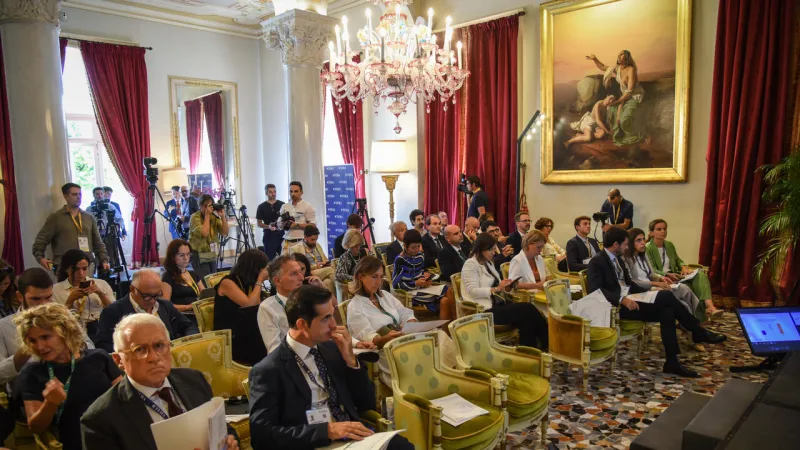
Cernobbio, Italy – A seminal research study unveiled at the prestigious Ambrosetti Forum in Cernobbio has exposed a resounding rejection of President Donald Trump's foreign policy by the global business community, with more than 90 percent of surveyed enterprises expressing substantial apprehension and disapproval. These findings emerged amid critical discussions involving prominent Italian political figures, including Elly Schlein, Giuseppe Conte, Matteo Renzi, and Gilberto Pichetto Fratin, all convened to deliberate pressing economic and geopolitical challenges.
The annual Ambrosetti Forum, an influential gathering of international leaders, policymakers, and business executives, serves as a significant barometer for global sentiment. The latest research, whose specifics were a focal point of debate, underscored a deep-seated concern within the private sector regarding the predictability and stability of international trade and diplomatic relations under the current U.S. administration.
Business leaders, both Italian and international, reportedly voiced worries over the impact of unilateral trade actions, geopolitical tensions, and the erosion of multilateral agreements on supply chains, market access, and investment climates. The consensus highlighted a perceived detriment to global economic interconnectedness, a cornerstone for thriving international commerce.
The sheer scale of the rejection—over 90 percent—signals a near-unanimous sentiment among companies that President Trump's approach to foreign affairs introduces unacceptable levels of risk and uncertainty. This substantial figure suggests that the business world prioritizes stability, rule-based international order, and predictable policy frameworks over more isolationist or protectionist agendas.
Italian political leaders present at the forum undoubtedly absorbed these findings with considerable interest. While their public statements often navigate complex diplomatic waters, the implications of such business sentiment for Italy's own economic trajectory and its position within European and global alliances are profound. Italy, a major export-oriented economy, relies heavily on a stable international environment.
The discussions at Cernobbio also delved into the specific mechanisms through which current foreign policy decisions are perceived to harm business interests. These include volatile tariff impositions, sanctions regimes impacting global trade flows, and a general cooling of international cooperative efforts that benefit cross-border investment and innovation.
Analysts suggest that the overwhelming disapproval stems from a fundamental divergence in philosophy between the business community, which thrives on open markets and predictability, and an administration often characterized by its transactional and disruptive foreign policy stances. This gap creates friction that directly translates into increased operational costs, reduced investor confidence, and stalled growth initiatives.
Historically, U.S. foreign policy has often sought to align with global economic interests, fostering an environment conducive to international trade and investment. The research presented at Cernobbio indicates a significant departure from this historical alignment, prompting a reassessment by businesses on how to navigate this evolving landscape.
Experts speaking at the forum emphasized the importance of diversified supply chains and new market strategies as companies adapt to an environment where traditional trade relationships are less assured. This adaptive shift, however, comes with its own set of costs and challenges, contributing to the widespread dissatisfaction.
The forum concluded with a shared understanding among participants that while national interests are paramount, the interdependence of the global economy necessitates a foreign policy that champions stability and cooperation. The stark findings on President Trump's foreign policy will undoubtedly inform future dialogues and strategic planning within both corporate boardrooms and government ministries across Europe and beyond.