Angela Stefani
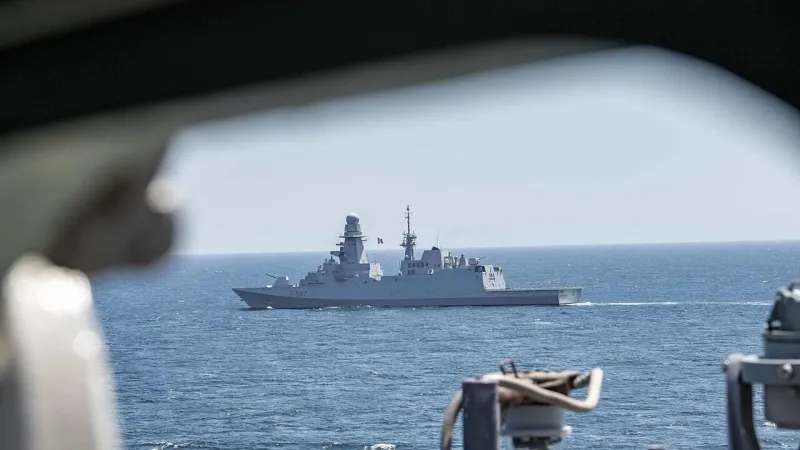
The Italian frigate Bergamini recently provided a critical escort for an Italian merchant vessel through the volatile Bab el-Mandeb Strait, a pivotal maritime chokepoint, as part of the European Union's Operation Aspides. The Italian Navy emphasized the timely and concrete nature of this security measure, underscoring its commitment to safeguarding international shipping lanes in a region beset by escalating tensions.
Operation Aspides, launched by the European Union, aims to protect commercial shipping from attacks in the Red Sea, the Bab el-Mandeb Strait, and the Gulf of Aden. This defensive mission, established in early 2026, directly responds to the persistent threats posed by Houthi rebels operating from Yemen, who have routinely targeted merchant vessels.
The Bab el-Mandeb Strait, meaning "Gate of Tears" in Arabic, is a narrow waterway connecting the Red Sea to the Gulf of Aden and the Indian Ocean. It is one of the world's most crucial shipping lanes, facilitating an immense volume of global trade, particularly oil and gas shipments destined for Europe and North America. Disruptions here have significant economic repercussions globally.
Since late 2025, Houthi militants have intensified their attacks on commercial vessels, often claiming solidarity with Palestinians. These assaults, involving drones, missiles, and fast boats, have forced many shipping companies to reroute their vessels around Africa's Cape of Good Hope, adding considerable time and cost to voyages.
A spokesperson for the Italian Navy stated that the escort mission by the Bergamini frigate served as "a concrete signal, arrived with excellent timing" within the framework of Operation Aspides. This statement highlights Italy's proactive stance in contributing to regional stability and ensuring freedom of navigation.
The Bergamini-class frigates are advanced multi-purpose vessels, equipped for anti-air, anti-surface, and anti-submarine warfare. Their deployment underscores the seriousness with which European nations, including Italy, view the security challenges in the Red Sea region. The vessel's presence provides a robust deterrent against potential aggression.
The EU's Operation Aspides operates alongside other international efforts, such as the United States-led Operation Prosperity Guardian. While differing in their specific mandates, both initiatives seek to restore security and confidence in a waterway critical for global commerce. These combined forces demonstrate a coordinated international pushback against maritime aggression.
The ongoing crisis has already disrupted global supply chains. Insurance premiums for vessels transiting the Red Sea have soared, and the extended voyages around Africa consume more fuel and incur additional labor costs. This directly impacts consumer prices and industrial output worldwide.
Beyond military intervention, diplomatic channels remain active, albeit with limited success, in addressing the root causes of the Houthi aggression. International bodies and individual nations continue to call for de-escalation and adherence to international maritime law to prevent further destabilization of the region.
The sustained presence of naval assets like the Bergamini frigate suggests that the international community is prepared for a prolonged effort to secure the Red Sea. The future of shipping through the Bab el-Mandeb Strait depends heavily on the effectiveness of these multinational operations and any eventual diplomatic breakthroughs.
This operation also reinforces Italy's growing role in international security missions, particularly in areas vital to its economic interests and strategic partnerships. Italy has consistently advocated for a strong European defense posture and contributes significantly to various multinational endeavors aimed at maritime security.
The Red Sea crisis is intricately linked to the broader geopolitical landscape of the Middle East. Tensions in the region, particularly those stemming from conflicts in Yemen and the ongoing Israel-Gaza conflict, directly influence the actions of non-state actors like the Houthis, complicating efforts for a lasting resolution.
The establishment of Operation Aspides reflects a strategic shift within the EU towards more assertive naval power projection, similar to previous anti-piracy operations off the coast of Somalia. This evolving strategy aims to safeguard economic interests and uphold international norms for safe maritime passage.